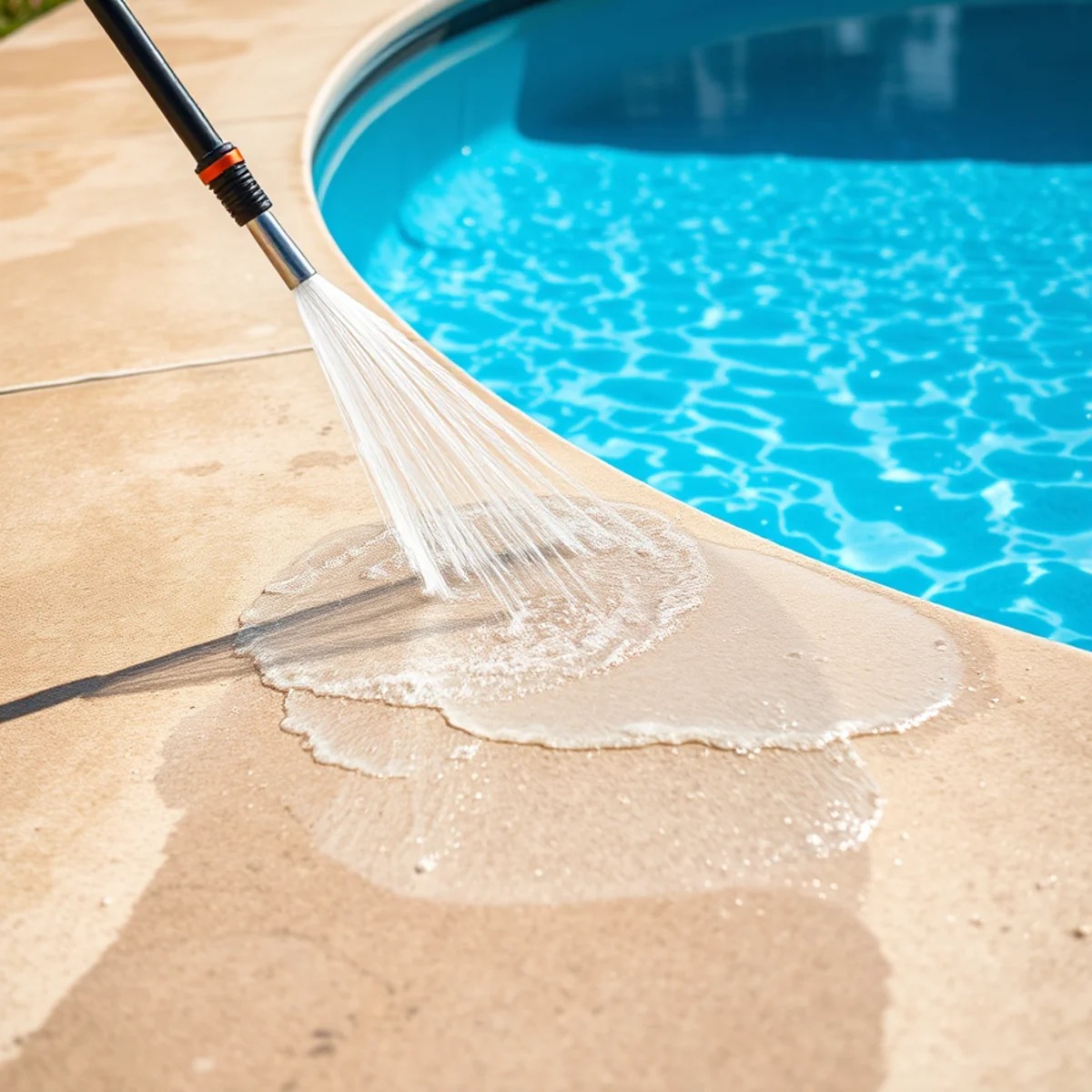
A material-by-material guide to cleaning a pool deck safely: correct PSI, nozzles, and chemistry for concrete, pavers, travertine, and stamped concrete.
A clean pool deck is not a cosmetic luxury. Wet algae on concrete and slick pavers around a pool are a genuine slip hazard, and the wrong cleaning method can etch the surface, blast out joint sand, or strip a sealer in a single pass. This guide walks Massachusetts homeowners through how to clean a pool deck safely, by material, with the right PSI and the right chemistry, so you protect both your family and the surface you paid for.
Why a Clean Pool Deck Matters for Safety and Curb Appeal
The number one reason to clean a pool deck is traction. A thin film of algae, mold, or mildew turns a textured deck into a skating rink the second it gets wet. Add running kids and bare feet, and a dirty deck becomes a liability. Slip resistance, not appearance, is the real job.
Curb appeal matters too. Your pool deck is the centerpiece of the backyard all summer. But the deeper benefit is preservation. Organic growth holds moisture against the surface, and trapped moisture is what drives staining, sealer failure, and freeze-thaw damage here in New England. Cleaning on a schedule extends the life of concrete, pavers, and stone by years.
Here is the core principle that should guide everything below: you don't need more pressure, you need the right chemistry. Pressure does not kill algae at the root. Biodegradable surfactants and the correct cleaning solution do. Crank the PSI to compensate for skipping the chemistry, and you will damage the deck before you ever solve the problem.
Identify Your Pool Deck Material First
Before you touch a pressure washer, identify what you are standing on. Material determines the safe pressure, the right tip, and the chemistry. Get this wrong and you can ruin a deck in minutes.
- Poured or broom-finished concrete. Durable but porous. Tolerates controlled pressure washing, but high PSI on a fixed spot will etch it.
- Stamped concrete. Decorative concrete molded to look like stone or brick, almost always sealed and often color-hardened. The sealer and color are the vulnerable layer, not the concrete.
- Pool deck pavers. Individual units set over a sand base with sand-filled (or polymeric-sand) joints. The pavers are tough; the joint sand washes out under a direct jet.
- Brick. Older and softer than concrete pavers, especially common around historic New England homes. Mortar joints and the brick face both erode under too much pressure.
- Travertine and natural stone. Premium, porous, and soft. Travertine, bluestone, and limestone scratch, pit, and dull easily. These demand the lowest pressure of any deck material.
- Kool Deck and cool-deck coatings. A textured acrylic-cement topping sprayed over concrete to stay cool underfoot. The texture is fragile. Aggressive pressure strips the coating right off.
If you can scratch the surface with a coin, or the joints are filled with sand, treat it as delicate and lean toward soft washing or very low pressure.
What Causes Pool Deck Stains and Slipperiness
Most pool deck problems are organic, which is good news, because organic growth responds to the right solution rather than brute force.
- Algae, mold, mildew, and black spots. Damp, shaded New England backyards near tree lines are algae factories. Black spots are often a hardy lichen or fungal growth that has rooted into the pores. This is what makes a deck slippery.
- Sunscreen, body oil, and lotion residue. Soaks into porous decks, attracts dirt, and smears if you skip a degreaser.
- Chlorine and salt residue. Splash-out from a chlorine or saltwater pool leaves a residue that dulls finishes and feeds further staining. Coastal salt air compounds it.
- Hard-water and calcium deposits. Mineral-rich water from sprinklers or fill lines leaves chalky white scale.
- Efflorescence. A white mineral haze that leaches up through concrete and pavers, extremely common on New England hardscapes.
- Pollen. Heavy spring oak and pine pollen coats and yellow-stains decks right before swim season.
- Leaf tannins. Fall leaves left on a deck bleed brown tannin stains and feed algae over winter.
- Rust. Metal furniture legs, umbrella stands, fertilizer, and pool hardware bleed orange rust that pressure alone will not remove.
Tools and Supplies You'll Need
You don't need a professional rig for routine maintenance, but you do need the right kit.
- Pressure washer with adjustable pressure, or a garden hose plus pump sprayer for soft-wash-style cleaning on delicate surfaces.
- Surface cleaner attachment (a flat, spinning-bar disc). This is the single best tool for even results on concrete with no wand stripes.
- Fan-tip nozzles, specifically a 40-degree (white) tip for general washing and a 25-degree (green) for stubborn spots. Skip the 0-degree red turbo tip on any pool deck.
- Stiff push broom and a hand scrub brush for working in solution and agitating stains.
- Pump sprayer or applicator for laying down cleaning solution evenly.
- Garden hose for pre-wetting plants and rinsing thoroughly.
- PPE: non-slip closed-toe footwear, eye protection, and chemical-resistant gloves.
Pressure Washing Safely: Correct PSI and Nozzle by Surface
This is where most DIY damage happens. Match the pressure to the material, use a fan tip, never a pinpoint jet, and keep the wand moving. Hold the tip roughly 12 inches off the surface and adjust from there. These are working ranges, not maximums to chase.
| Surface | Target PSI | Nozzle / tool | Notes |
|---|---|---|---|
| Travertine / natural stone | 1,000 or less | 40-degree, soft wash preferred | Softest material; test first |
| Brick (historic) | Under 400 | 40-degree, soft wash | Protect mortar joints |
| Kool Deck / cool-deck coating | Soft wash, very low | 40-degree at distance | Coating strips easily |
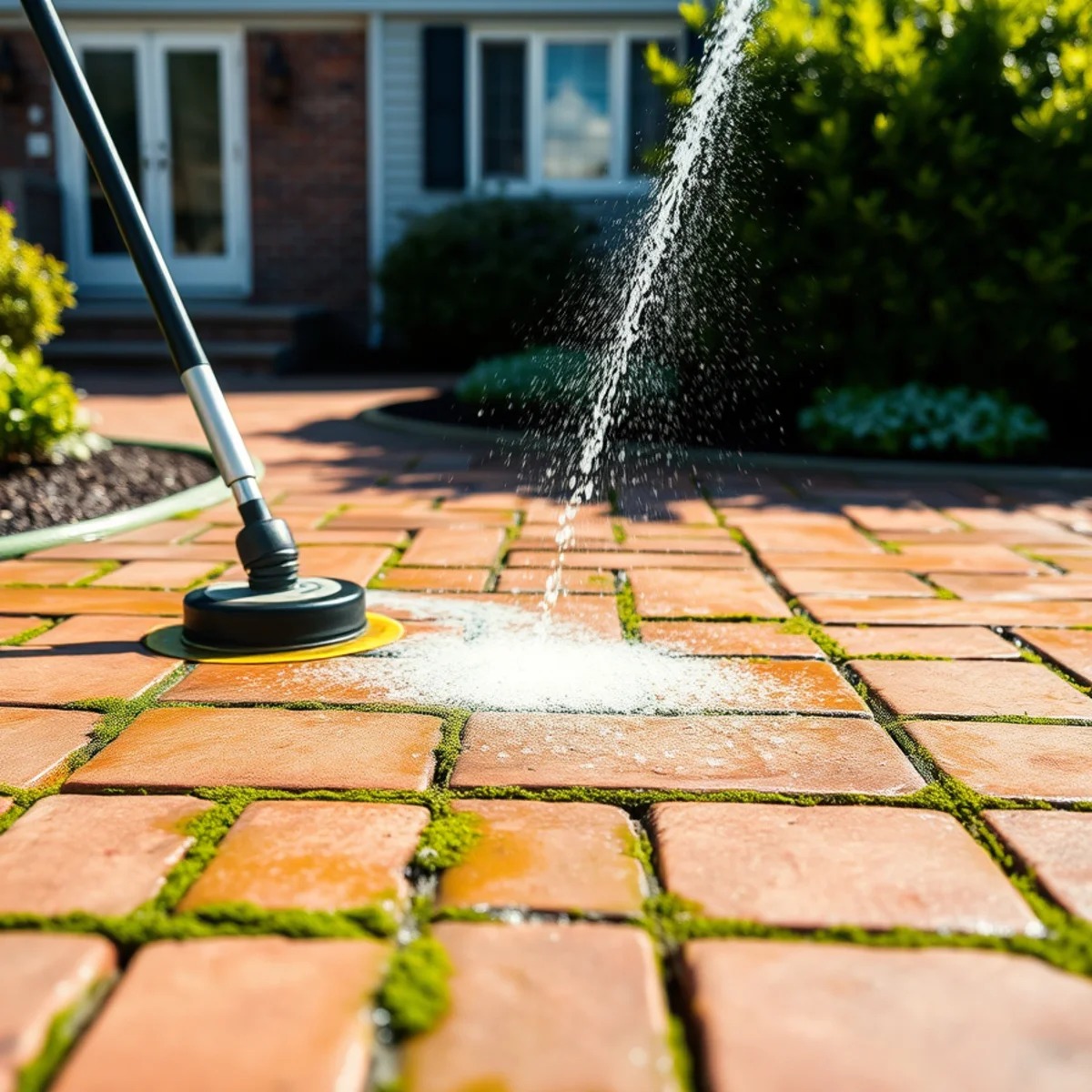
| Pool deck pavers | 500 to 1,500 | 40-degree or surface cleaner | Protect joint sand, re-sand after |
| Stamped / sealed concrete | 1,000 or less | 40-degree, surface cleaner | Protect sealer and color |
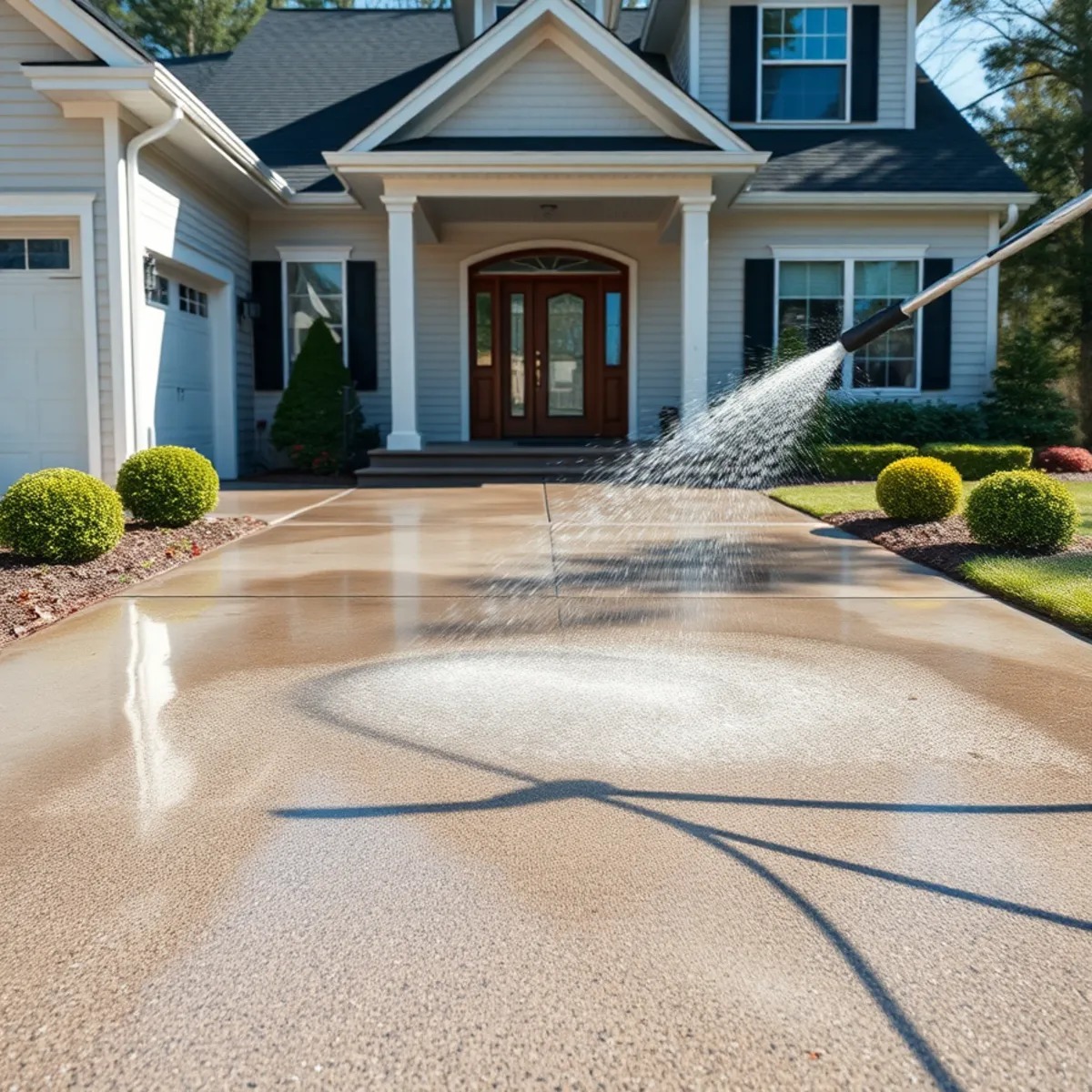
| Poured / broom-finished concrete | 1,500 to 2,500 | Surface cleaner | Keep moving to avoid etching |
A few rules that hold for every surface. Keep the wand at a consistent distance and angle so you don't leave stripes or zebra marks. Never linger on one spot. Work in overlapping passes. And always test a small, hidden area first, especially on stone, pavers, stamped concrete, or anything sealed.
Soft Washing vs Pressure Washing: Which Method for Which Material
Soft washing and pressure washing are different tools for different jobs, and the smartest pool deck cleanings use both.
Pressure washing uses mechanical force to lift dirt. It is fine for plain poured concrete and durable pavers, where the surface can take controlled pressure and a surface cleaner gives even results. It physically removes grime, but it does not kill the organism causing algae and black spots, so the growth returns.
Soft washing uses low pressure (think garden-hose force) plus a cleaning solution that kills algae, mold, and mildew at the root. It cleans deeper, the results last far longer, and it will not carve up the surface. For travertine, brick, stamped concrete, Kool Deck, and anything sealed, soft washing is the professional standard.
The practical answer for most decks: soft wash to kill the biology, then do a light, controlled rinse or low-pressure pass to remove what is left. If you have never been sure which approach your deck needs, that judgment is exactly what a dedicated pool deck cleaning service brings.
Best Cleaning Solutions (and What Not to Use)
Chemistry does the real work. Here is what belongs on a pool deck and what does not.
What works
- Oxygenated bleach (sodium percarbonate). Color-safe and sealer-friendly, gentle on plants when diluted, and effective on organic stains. The safest first choice for stamped, colored, or sealed decks.
- Diluted chlorine bleach (sodium hypochlorite). The most effective killer of algae, mold, and black spots. Use it diluted, control the runoff, and keep it off colored concrete and metal. This is the active ingredient in professional soft-wash mixes.
- Enzyme and biocide cleaners. Targeted biological cleaners that digest organic buildup with minimal collateral risk.
- A squirt of dish soap added as a surfactant to help solution cling and spread.
- Diluted white vinegar for light hard-water spotting on tolerant surfaces only.
Always give your solution dwell time per the label. Let it sit and work, but never let it dry on the surface, and work in shade when you can.
What to avoid
- Muriatic (hydrochloric) acid for general cleaning. It etches concrete, burns plants, and pits stone.
- Vinegar or any acid on travertine, limestone, or marble. Acid dissolves calcium-based stone permanently.
- Full-strength chlorine bleach on colored or stamped concrete, which can fade the color.
- The 0-degree turbo nozzle. It gouges almost every deck surface.
- Dumping any cleaner into the pool. It wrecks your water chemistry.
Step-by-Step: How to Clean a Concrete Pool Deck Safely
For a straightforward concrete deck, follow this sequence.
- Clear the deck. Remove furniture, toys, planters, and the pool cover. Sweep off leaves and grit so you don't grind debris into the surface.
- Protect the pool and plants. Pre-wet all nearby vegetation so it absorbs less runoff, and minimize solution entering the pool.
- Pre-treat. Apply oxygenated bleach or a diluted soft-wash solution to algae, mold, and stains. Let it dwell, but don't let it dry.
- Agitate stubborn areas with a stiff brush or push broom.
- Wash with the right tool. Use a surface cleaner or a 40-degree fan tip, keep the wand moving, and hold a consistent distance to avoid etching and stripes.
- Rinse thoroughly. Direct rinse water toward an appropriate drain and away from the pool, then re-rinse plants to dilute any overspray.
- Dry and inspect. Check for missed spots, etching, or sealer wear before replacing furniture.
How to Clean Pavers Without Blowing Out the Joint Sand
Pavers are the trickiest DIY deck because the sand between them is both structural and vulnerable. Lose the joint sand and pavers shift, tilt, and trip people.
- Keep pressure at 500 to 1,500 PSI and use a 40-degree tip or a surface cleaner, never a pinpoint jet aimed straight into the joints.
- Hold the wand at a low angle and keep moving. Sweep across joints, don't blast down into them.
- Let chemistry do the work so you can stay at lower pressure. Pre-treat with a soft-wash solution to kill embedded algae rather than chasing it with force.
Re-sanding after cleaning
Expect to lose some joint sand no matter how careful you are. Once the pavers are fully dry (give it a day or two), refill the joints. Sweep fine polymeric sand into the joints, tamp or vibrate it down, brush off every speck from the paver faces, then lightly mist to activate the binder. Polymeric sand hardens to resist washout and weeds. This re-sanding step is the difference between a clean deck and a clean deck that stays stable. For deep paver work and joint stabilization, our paver cleaning crews handle the wash and the re-sand together.
How to Remove Black Spots, Algae, and Mold
Black spots, green algae, and the slick film that makes a deck dangerous are all biological. Pressure alone pushes them around and they grow right back within weeks.
The lasting fix is chemical. Apply a diluted sodium hypochlorite or oxygenated-bleach solution, let it dwell so it kills the organism through the root, agitate the worst patches, then rinse. Black lichen spots are stubborn and may need a second spot treatment. Because this is a living problem, it is treated as its own specialty rather than a quick rinse. Our algae removal approach targets the biology so growth stays gone far longer than a power-wash-only pass.
Removing Tough Stains: Rust, Hard Water, and Tannins
Some stains ignore both pressure and standard cleaners. Match the product to the stain.
- Rust stains. From furniture legs, umbrella stands, and fertilizer. Pressure spreads them. You need an oxalic-acid-based rust remover applied as a spot treatment. Targeted rust removal lifts the stain without bleaching the surrounding deck.
- Hard-water and calcium deposits. Chalky white scale responds to a mild acidic descaler, but never use acid on travertine or limestone. Test first.
- Efflorescence. That white mineral haze needs a dedicated efflorescence removal product, not ordinary detergent, because it is salt leaching from within the masonry.
- Leaf tannin and organic stains. Brown leaf shadows respond well to oxygenated bleach and dwell time. Clearing fall leaves promptly prevents them in the first place.
Protecting Your Pool, Plants, Pets, and Furniture
Responsible cleaning protects everything around the deck, not just the deck itself.
- Pre-wet vegetation before and after you apply any solution. Saturated leaves and roots absorb far less runoff.
- Divert and contain runoff. Keep bleach-laden water out of the pool, off the lawn, and away from storm drains, wetlands, and well heads. In wetland-adjacent and coastal Massachusetts yards, runoff containment is not optional.
- Cover or relocate furniture and cushions, and move pet bowls and toys.
- Keep solution out of the pool to protect your water chemistry; cover the water where practical.
- Keep kids and pets off the deck until it is rinsed and dry.
- Rinse thoroughly at the end to dilute any residue.
Don't Damage Your Sealer: Sealed and Stamped Concrete
Stamped and decorative concrete is almost always protected by a penetrating sealer or, more often around pools, a glossy acrylic sealer. That sealer is sacrificial, and high pressure or harsh acid will strip it. Once it is gone, the color and the concrete underneath are exposed.
So on sealed or stamped concrete, stay at 1,000 PSI or less, use a 40-degree tip or surface cleaner, and lead with gentle chemistry rather than force. A stripped sealer is not the end of the world, but it does mean resealing is now part of the job. Most pool decks need resealing every two to three years anyway, and right after a thorough cleaning, once the deck is bone dry, is the ideal time to reapply. Fresh sealer restores the color, blocks water intrusion ahead of winter, and makes the next cleaning easier.
Making the Deck Slip-Resistant
Since slip safety is the whole point, build it into your routine.
- Add a non-slip additive to your sealer. A fine polymer or silica grit mixed into the topcoat restores traction on a slick sealed deck without changing how it looks much.
- Rinse off chlorine and sunscreen regularly. Both build up into a slippery film. A quick hose-down after heavy pool days makes a real difference.
- Stay ahead of algae. A clean, algae-free deck is a slip-resistant deck. Routine rinsing in shaded, damp areas keeps the biology from re-establishing.
How Often Should You Clean Your Pool Deck
A full deep clean once or twice a year handles most decks: a spring clean before you open the pool and, ideally, a fall clean before you close it. Between those, light maintenance keeps it safe. Hose off pollen, sunscreen, and chlorine splash-out regularly, and clear leaves promptly in fall.
Shaded, damp, tree-lined Massachusetts yards regrow algae fast and may need more frequent attention. Coastal properties dealing with salt air often do too. Reseal stamped or decorative concrete every two to three years.
DIY vs Hiring a Professional
Plenty of homeowners can handle a light maintenance wash on a basic poured-concrete deck. Bring in a fully insured professional when:
- The deck is pavers, travertine, brick, stamped, or colored concrete.
- There are stubborn rust, efflorescence, hard-water, or deep organic stains.
- The surface is large, sloped, or surrounds an in-ground pool with nearby electrical equipment.
- You want to avoid the real risks: etching, sealer stripping, blown-out joint sand, and faded color.
As for cost, professional pool deck cleaning in Massachusetts is typically priced by square footage, surface type, and stain severity, and it is a small fraction of the replacement cost of a paver or stamped-concrete deck. We don't publish flat figures because every deck is different, but an on-site estimate is free. Professionals match pressure and chemistry to the exact material, contain runoff responsibly, protect your pool chemistry, and bring a hot water pressure washing option that cuts through stubborn organic buildup and oil while staying gentle on the surface.
Massachusetts-Specific Pool Deck Care
New England gives pool decks a short, intense season and a punishing off-season, so timing is everything.
- Spring (pre-season). Heavy oak and pine pollen coats decks before Memorial Day. An early-spring clean clears the pollen film and the winter's algae so the deck is safe and bright for opening.
- Fall (pre-close). Dense deciduous canopy drops leaves that bleed tannin stains and feed algae all winter under the cover. Clean before you close the pool, and seal before road-salt season to block water intrusion.
- Freeze-thaw. New England's freeze-thaw cycles widen cracks and spall concrete edges. High pressure worsens already-damaged edges, so inspect first and use gentle pressure around cracks and joints.
- Shade and humidity. Damp, shaded inland yards regrow algae and black spots quickly; routine rinsing matters more here than almost anywhere.
- Coastal salt. On the South Shore, Cape, and North Shore, salt air and saltwater-pool splash-out leave residue that degrades joint sand and sealer. Rinse it off regularly.
We see this rhythm across our service area, from Duxbury and Plymouth on the South Shore to Barnstable on the Cape, where paver and stamped-concrete pool decks take a real beating from salt air and freeze-thaw.
Year-Round Maintenance Checklist
- Weekly in season: hose off pollen, sunscreen, and chlorine splash-out; clear debris.
- Spring: deep clean before opening; treat any algae or black spots.
- Summer: rinse after heavy use; spot-treat stains while fresh.
- Fall: clear leaves promptly; deep clean before closing; reseal if due.
- Before winter: confirm the deck is clean, dry, and sealed to limit freeze-thaw water intrusion.
For the concrete cleaning and patio cleaning that surrounds many pool areas, the same seasonal logic applies.
Get a Free Pool Deck Cleaning Estimate
Wash Bros was founded in 2023 by brothers Louis and Dominic, and we've earned a 5.0 average across 130 Google reviews by treating every Massachusetts property like our own. We're fully insured, with a certificate of insurance available on request, and we match the right pressure and chemistry to your exact deck, contain runoff responsibly, and protect your pool and plantings while we work. Call +1 (351) 242-0666 or contact us for a free estimate, and let's get your deck safe and spotless for the season.
Frequently Asked Questions
Need Professional Exterior Cleaning?
Wash Bros provides affordable, dependable pressure washing across Massachusetts. Get your free estimate today.
Get a Free Estimate