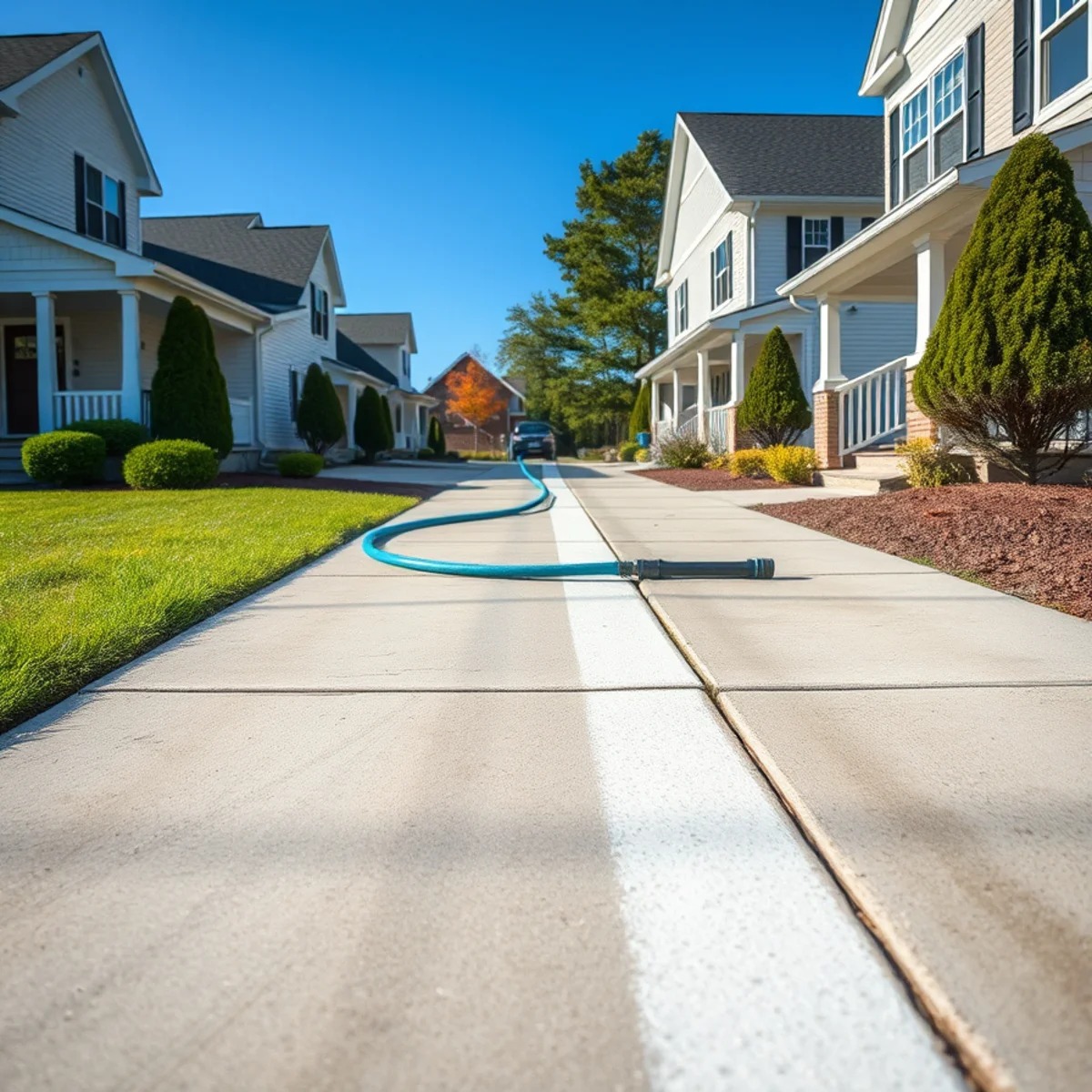
Clean sidewalks aren't just curb appeal. Learn how algae, salt, and freeze-thaw create slip and liability risks in MA, plus the right way to clean concrete safely.
Your sidewalk is the first surface a visitor, a neighbor, or a home buyer actually touches, yet it is usually the last one anybody cleans. A clean walkway is not just about looks: it strips off the slick algae and moss that send people to the ground, and it slows the salt-and-freeze damage that quietly destroys New England concrete. This guide walks through everything that matters for Massachusetts property owners, from slip-and-fall liability to the right PSI, so you can keep your walkways safe, sharp, and intact year-round.
Why Your Sidewalk Is the First Thing Visitors and Buyers Notice
First impressions form in seconds, and the path to your front door is part of that snapshot whether you intend it or not. A bright, even sidewalk frames the property and reads as "this whole place is cared for." A streaky, green-tinged one undercuts fresh paint, new landscaping, and a clean roof, because the eye lands on the ground people are about to walk across.
That snapshot matters most in three moments: when you are selling, when you are entertaining, and when customers are deciding whether to walk into your business. Buyers and their agents walk the front path first, and clean concrete simply photographs better in listing photos. For a storefront, the entrance walkway is the handshake before anyone reaches the door.
What Builds Up on Massachusetts Sidewalks
The stains on a neglected walkway are not one problem; they are a stack of different problems, and each one responds to a different treatment.
- Algae and green organic growth. That green film on shaded concrete is living. It feeds on moisture and pollen, spreads fast in humid New England summers, and turns dangerously slick when wet.
- Moss and lichen. Moss holds water against the surface like a sponge and creates uneven, spongy footing. Lichen bonds tightly to concrete and is one of the most stubborn things to remove without the right chemistry.
- Black streaks and mildew. The dark stains on north-facing slabs are mold and mildew colonies, not just dirt. Scrubbing barely touches them.
- Ground-in dirt and pollen. Spring pollen coats everything in Massachusetts, then bakes into a yellow-gray haze that ordinary rain will not rinse away.
- Road salt and deicer residue. Winter salt leaves a white, gritty film that both feeds organic growth and accelerates concrete breakdown.
- Efflorescence. The chalky white crystalline residue that surfaces on concrete and pavers is efflorescence, mineral salts pushed out of the slab by moisture. It is cosmetic but it makes a walkway look perpetually dirty.
- Oil, grease, gum, and rust. Driveway aprons and commercial walkways collect oil drips, dropped gum, and orange rust streaks from fertilizer spreaders, railings, and metal furniture.
Because the surface is porous, most of this works its way into the concrete rather than sitting on top. That is exactly why a garden hose accomplishes so little, and why the right cleaning solution matters far more than brute force.
How Slippery Buildup Causes Slip-and-Fall Accidents
It is easy to file a grimy sidewalk under "cosmetic," but the real issue is traction. The green and black film on shaded concrete is a thin biological layer, and once it gets wet from morning dew, rain, or melting snow, it behaves like a coat of grease over the surface.
Moss makes it worse by creating uneven, spongy footing that rolls ankles, while leaf stains and sap hide the actual edge of a step. For a household, that is a fall risk for kids, older relatives, and delivery drivers carrying boxes they cannot see over. For a business, it is a steady, avoidable liability. Regular sidewalk cleaning is one of the cheapest ways to restore a slip-resistant surface before someone gets hurt, and it pairs naturally with broader concrete cleaning of your driveway and walkways in one visit.
The Liability Angle: Massachusetts Premises Liability Law
This is where Massachusetts owners need to pay attention, because the legal landscape here is stricter than most homeowners assume.
For decades, Massachusetts followed the "natural accumulation rule," which largely shielded property owners from liability for snow and ice that gathered naturally. That changed in 2010, when the Supreme Judicial Court decided Papadopoulos v. Target Corporation and abolished the distinction between natural and unnatural accumulation. Today, Massachusetts property owners owe a duty of reasonable care to keep their walkways reasonably safe for lawful visitors, the same standard that applies to any other hazard on the property.
Slippery algae and moss fall squarely inside that duty. A walkway does not have to be icy to be hazardous; a wet, algae-coated path that a reasonable owner should have addressed can support a premises liability claim if someone is injured. On the snow-and-ice side, Massachusetts General Laws Chapter 84, Section 18 sets notice requirements for claims involving public ways, and municipal ordinances reinforce the culture of prompt clearing. Boston, for example, generally requires commercial owners to clear snow within 3 hours and residential owners within 6 hours of a storm ending; Worcester allows roughly 12. The takeaway is simple: in Massachusetts, keeping your walkway safe is an expectation, not a courtesy.
Why This Hits Commercial Owners Harder
For a storefront, HOA, or restaurant, the math is unforgiving. A single slip-and-fall settlement commonly lands in the tens of thousands of dollars and can climb well past six figures once medical costs, lost income, and legal fees are added; figures in the $50,000 to $150,000-plus range are widely cited as typical, though every case differs. ADA guidance also treats a vertical change of more than a quarter inch in a walking surface as a trip hazard that must be addressed. Routine cleaning will not fix a heaved slab, but it removes the slick film that turns a minor surface into a genuine fall risk, and it documents that you take walkway safety seriously.
How Clean Sidewalks Boost Curb Appeal and Property Value
Sidewalk cleaning delivers an outsized visual return for a modest cost; few projects make a property look this much fresher this fast. When you are preparing a home for resale, the front walkway is part of every listing photo and every showing, and clean concrete signals a maintained property to buyers before they reach the threshold.
The effect compounds with the rest of your exterior. A clean walkway next to clean siding and a clean roof reads as a coherent, cared-for home; a green-streaked path next to those things reads as an afterthought. Many homeowners book sidewalk service alongside house washing or driveway cleaning precisely so the whole front elevation lifts together rather than one clean surface highlighting a dirty one.
Signs Your Sidewalk Needs a Professional Cleaning
You usually do not need a moisture meter to know it is time. Watch for:
- Green or black discoloration, especially on the shaded, north-facing sections.
- A slick feel underfoot when the surface is wet, the clearest safety red flag.
- Dark streaks or a haze that survives a good rain.
- White chalky residue (efflorescence) or a gritty salt film after winter.
- Spongy moss in the joints or low spots, or weeds prying the sections apart.
- Oil, rust, or gum that has settled in and will not scrub off.
If two or more of these are present, the buildup has likely moved past what a hose and a stiff brush can handle, and a treatment-based cleaning will both look better and last longer.
How Professional Sidewalk Cleaning Works
A proper sidewalk cleaning is a sequence, not a single pass with a wand. Done right, it looks like this:
- Inspection and pre-soak. The crew reads the surface, identifies the staining, and pre-wets nearby plants and grass so cleaning solution cannot concentrate on landscaping.
- Pre-treatment. A measured cleaning solution, typically a controlled sodium hypochlorite (bleach) blend with surfactants for organic growth, or a dedicated degreaser for oil, is applied and allowed to dwell. This is the step that actually kills algae, moss, and mildew at the root.
- Agitation and dwell. The solution sits long enough to break down the growth and lift staining so that very little pressure is needed afterward.
- Surface-cleaner pass. A flat surface-cleaner attachment, a spinning bar enclosed in a housing, glides across the slab and delivers an even, stripe-free clean without the zebra marks a bare wand leaves.
- Spot stain removal. Targeted treatment hits anything left behind: rust, deep oil, gum.
- Rinse and final check. A thorough rinse clears residue, and runoff is directed away from storm drains and sensitive plantings.
The order matters. When chemistry does the killing, pressure only has to do the rinsing, which is gentler on the concrete and gives a result that stays clean for far longer.
Pressure Washing vs. Soft Washing for Sidewalks
Not every walkway should be hit at full pressure, and choosing the wrong method is how surfaces get wrecked.
When Pressure Washing Is the Right Call
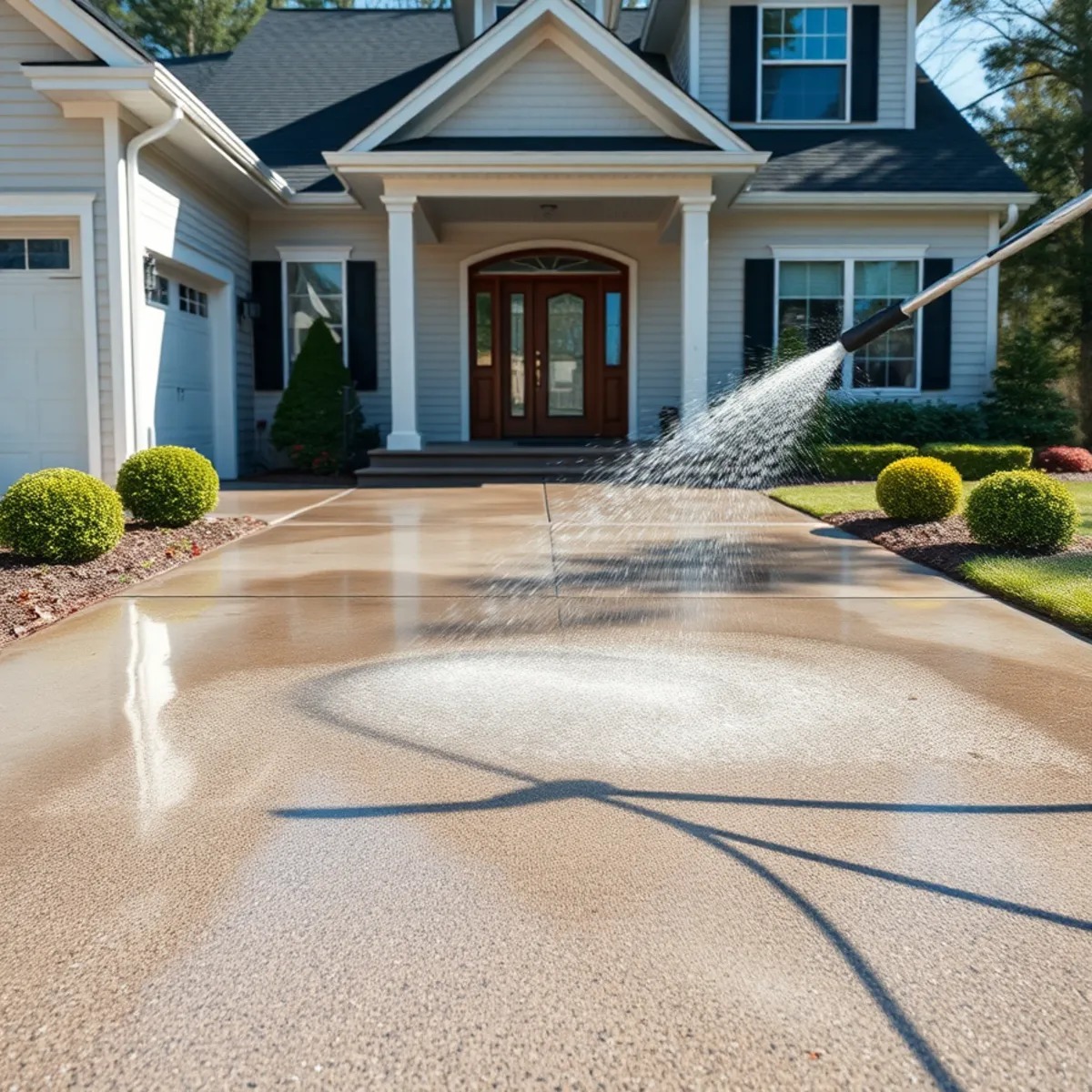
Solid, poured concrete in good condition handles direct pressure washing well, paired with the right cleaning solution and a surface-cleaner attachment for an even finish. Concrete is the one common walkway material that tolerates real pressure, in the range of roughly 2,000 to 3,000 PSI for ground-in grime, when a pro controls the nozzle and distance.
When Soft Washing Wins
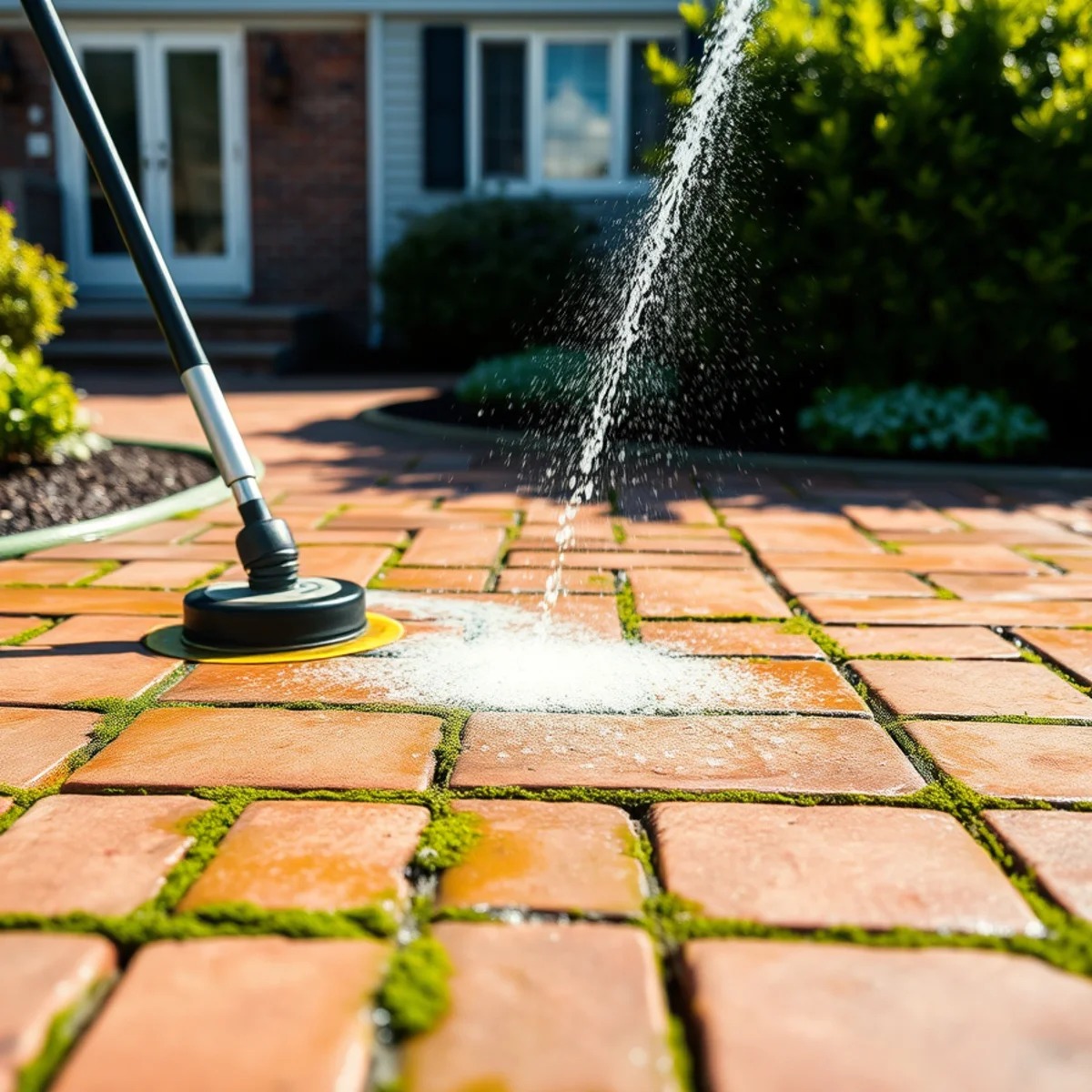
Older, cracked, or decorative surfaces, and especially pavers, call for soft washing: low pressure plus specialized solutions that kill growth at the root instead of blasting the top layer off. On interlocking pavers, soft washing avoids stripping the joint sand that locks everything in place. The guiding principle across our work is the same one we apply to roofs and siding: you don't need more pressure, you need the right chemistry. Pressure does not kill algae roots; biodegradable surfactants do, which is why a soft-washed surface stays clean longer than a blasted one.
Does Pressure Washing Damage Concrete?
Yes, it can, and this is the most common way a DIY job goes wrong. Concrete looks bulletproof, but too much pressure held too close, or the wrong nozzle, will etch and pit the surface, leaving permanent wand marks, a rough texture, and zebra striping that is obvious the moment the slab dries.
A few plain-language rules keep concrete safe:
- GPM matters more than PSI. Gallons per minute (GPM) is what actually carries dirt off the surface; high PSI with low flow tends to etch rather than clean. A pro balances both.
- Use the right tip angle. A narrow 0-degree "red" tip is a gouging tool, not a cleaning tool. Wider 25- to 40-degree fans, or better yet a surface cleaner, distribute force safely.
- Keep distance and keep moving. Concentrating the stream in one spot, or hovering, is what carves the lines you cannot undo.
- Let chemistry lead. When the pre-treatment kills the growth, you can clean at lower pressure and skip the etching risk entirely.
For homeowner reference, correct pressure varies enormously by surface: asphalt shingles and most roofs should be soft-washed under about 100 PSI, vinyl siding sits around 100 to 500, historic brick stays under 400, and only a concrete driveway or sidewalk tolerates the 2,000 to 3,000 range. Pointing driveway pressure at brick or siding is how irreversible damage happens.
Removing Tough Stains: Oil, Grease, Rust, Gum, and Organic Streaks
Each stubborn stain is its own chemistry problem, and water alone solves none of them.
- Oil and grease. These need a dedicated degreaser to break the bond and, ideally, hot water; our oil stain removal approach lets the degreaser dwell so the stain lifts rather than smears. Fresh drips come up far more easily than ones that have cured for months.
- Rust. Orange rust streaks from fertilizer, railings, or metal furniture need an oxalic or specialized acid-based rust removal treatment, never just pressure, which only spreads them.
- Gum. On commercial walkways, gum responds best to heat or a freeze-and-scrape approach plus a surfactant, not a high-pressure blast that leaves a smear.
- Black and green organic streaks. The single most important point: these are alive. A sodium hypochlorite blend with surfactant kills them at the root. Pressure-washing organic growth off without treating it just removes the visible top layer, and it grows back in weeks.
Why Massachusetts Sidewalks Get Dirty Fast
New England is genuinely hard on concrete, and the reasons are specific to our climate.
- Freeze-thaw cycles. Porous concrete absorbs water, and when that water freezes it expands roughly 9 percent. Over a Massachusetts winter of repeated freezing and thawing, that expansion causes surface scaling and spalling, where the top layer flakes away. Regular cleaning and sealing slow this New England-specific deterioration.
- Road salt and deicers. The salt used heavily across Massachusetts winters drives more water into the concrete, accelerates freeze-thaw spalling, and leaves residue that feeds both efflorescence and organic growth. That residue is the main reason a spring cleaning matters here.
- Humidity and tree cover. Humid summers combined with heavy tree canopy keep shaded, north-facing walkway sections damp, which is exactly the condition algae, moss, lichen, and black mildew need to thrive.
- Pollen. Spring pollen blankets Massachusetts sidewalks in a yellow film that both looks bad and feeds organic growth.
This is the gap most national cleaning articles miss: they treat sidewalks as a warm-climate, cosmetic-only surface. In Massachusetts, the salt, the freeze-thaw, and the shade make routine cleaning a structural-maintenance issue, not just an appearance one.
How Often Should You Clean Your Sidewalk in Massachusetts?
There is no single answer, because shade, tree cover, and foot traffic all matter. As a qualitative guideline:
- Once a year suits most homes, ideally in late spring after pollen settles and winter salt residue is still fresh enough to rinse easily.
- Twice a year fits heavily shaded walkways, properties under dense tree cover, and commercial entrances with steady foot traffic.
- As needed for spot problems: a fresh oil drip, a rust stain from a spreader, or storm debris.
A walkway cleaned on a schedule almost never reaches the dangerous, deeply stained stage, which keeps every future cleaning faster, gentler, and less expensive. Spring is the sweet spot in our climate because it clears the slick film and salt left by a long, damp winter before summer traffic sets it in.
Should You Seal Your Sidewalk After Cleaning?
For Massachusetts concrete, sealing is one of the most underrated steps, and it is worth real consideration. A penetrating sealer soaks into the concrete pores and reduces how much water and salt the slab can absorb. Because freeze-thaw spalling and salt damage both start with absorbed moisture, a good penetrating sealer directly slows the two biggest threats to New England walkways.
The timing rule is straightforward: clean first, let the surface dry fully, then seal. Sealing over trapped moisture or dirt locks the problem in. A typical residential sidewalk benefits from resealing every couple of years, ideally before road-salt season in the fall. Sealing will not turn old concrete new, but it meaningfully extends the life of a slab that faces Massachusetts winters.
DIY vs. Hiring a Professional Sidewalk Cleaning Service
A rented pressure washer can handle a small, simple stretch of sidewalk, and for some homeowners that is genuinely enough. But people across Massachusetts hand this job to a pro for concrete reasons:
- Even, stripe-free results. Without a surface cleaner and the right tip, DIY work leaves wand marks and missed spots that show the moment the surface dries.
- Surface safety. Too much pressure pits concrete, etches pavers, and blows out joint sand, and that damage is permanent.
- Stains that actually leave. Deep organic growth, rust, and oil need the correct dwell-time chemistry, not just water.
- Time, equipment, and runoff. Hauling gear, mixing solutions safely, protecting landscaping, and managing runoff eats a weekend. A crew handles it in a fraction of the time.
When you hire, hire carefully. In Massachusetts, ask whether the company is fully insured and request a certificate of insurance; for any larger home-improvement work, homeowners are also wise to confirm a contractor's HIC registration. An uninsured "guy with a truck" who etches your slab or floods a neighbor's yard becomes your problem fast.
How Much Does Sidewalk Cleaning Cost in Massachusetts?
Honest answer: it depends, and anyone quoting a flat number sight unseen is guessing. The real cost factors are square footage, how heavy the staining is, the surface type (poured concrete versus pavers versus decorative), accessibility, and whether you add sealing or pair it with other services. A small, lightly soiled residential walkway is an inexpensive job; a large commercial frontage with deep oil and gum staining is more involved.
The smart way to think about it is comparison: a routine cleaning is a fraction of the cost of resurfacing or replacing a spalled, salt-damaged slab, and a tiny fraction of a slip-and-fall claim. Bundling sidewalk cleaning with a driveway cleaning or house wash usually lowers the per-surface cost, too. For an exact figure, a quick on-site or photo estimate is the only accurate route.
Sidewalk Cleaning for Commercial Properties, HOAs, and Storefronts
For commercial owners, sidewalk cleaning is risk management as much as appearance. A clean storefront entrance shapes the first impression of every customer, and a slick or stained one does the opposite. HOAs carry the added duty of shared walkways used by residents and guests, where a neglected path becomes a board-level liability question.
The commercial case rests on three pillars: safety (slip-resistant, ADA-aware walking surfaces), liability (documented, routine maintenance under Massachusetts premises law), and image (high-traffic entrances that look maintained). Scheduled service for storefronts, restaurants, and HOA properties keeps gum, grime, and organic growth from accumulating in the first place, which is far cheaper than reacting after a complaint or an injury. Busy corridors in Boston and downtown Worcester especially benefit from a recurring schedule.
Eco-Friendly Sidewalk Cleaning and Runoff
Cleaning a sidewalk responsibly means thinking about where the water goes. Done carelessly, runoff carries cleaning solution and lifted grime toward storm drains, gardens, and, in many Massachusetts towns, into systems near wells and waterways.
A conscientious crew uses biodegradable surfactants where the job allows, dilutes appropriately, pre-soaks surrounding plants and grass so solution cannot concentrate on them, and practices runoff containment to keep treated water out of storm drains. On properties with private wells, that awareness matters even more. The goal is a walkway that is genuinely clean without trading the lawn, the garden, or the groundwater for it. This is the same eco-conscious approach we bring to every soft washing job across the state, from tree-lined Newton to the coastal North Shore.
Book Wash Bros for Sidewalk Cleaning
If your walkways look dull, slick, or stained, we would be glad to help. Wash Bros is a fully insured, family-run team, founded in 2023 by brothers Louis and Dominic, with a 5.0 average across 130 reviews built on careful, consistent work. We will read your specific surface, pick the right method and chemistry, protect your landscaping, and leave you with a sidewalk that is safe to walk and good to look at. Reach out through our contact us page or call +1 (351) 242-0666 for a free, no-pressure estimate. Clean, safe, great-looking sidewalks are closer than you think.
Frequently Asked Questions
Need Professional Exterior Cleaning?
Wash Bros provides affordable, dependable pressure washing across Massachusetts. Get your free estimate today.
Get a Free Estimate