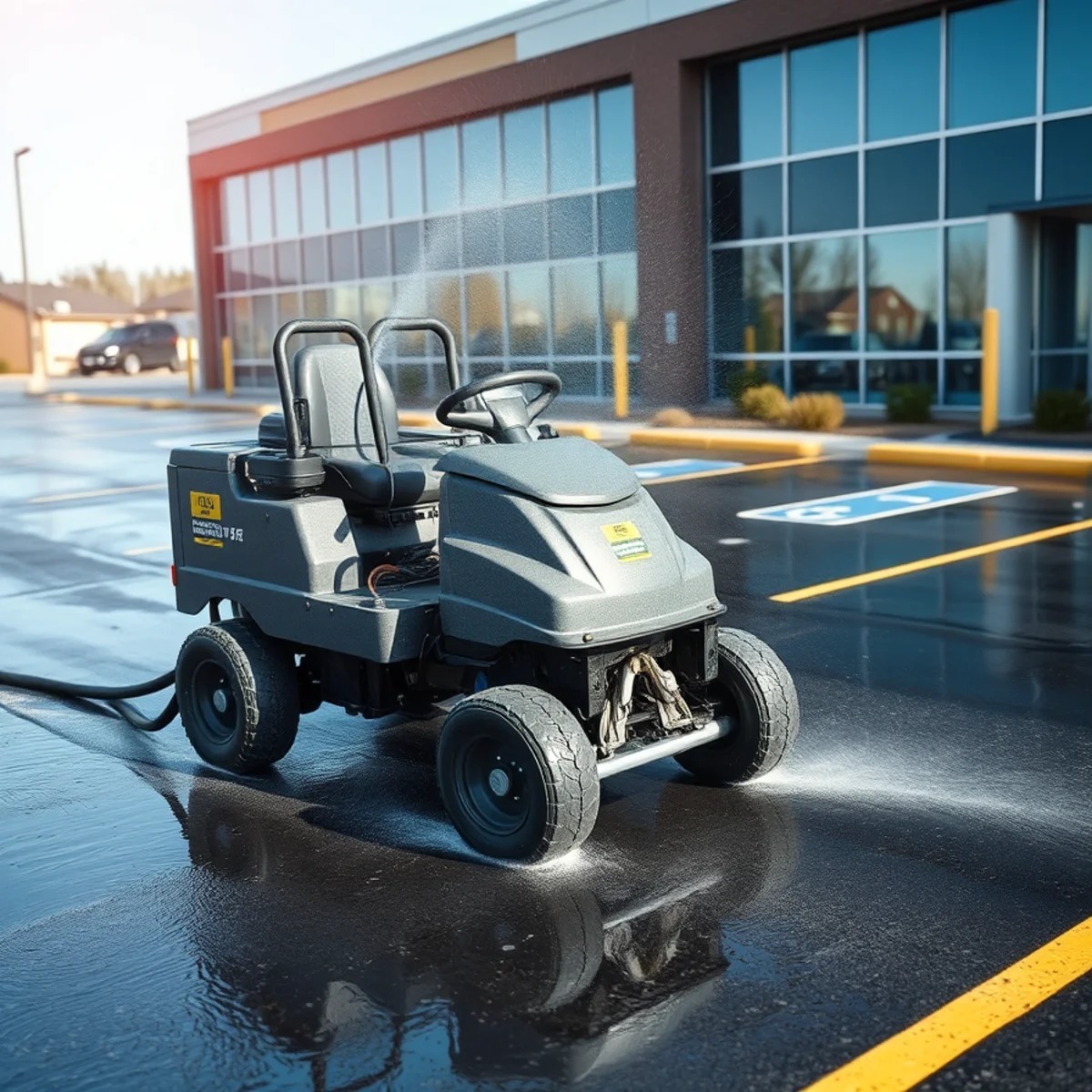
A veteran MA contractor's guide to commercial parking lot pressure washing: PSI specs, oil and salt removal, stormwater compliance, seasonal timing, and costs.
Your parking lot is the first thing customers, tenants, and inspectors see, and in Massachusetts it absorbs a brutal year of road salt, freeze-thaw cycles, oil drips, gum, and leaf tannins. A clean, clearly striped lot tells visitors you sweat the details and gives you documentation that protects you from slip-and-fall claims. This guide covers the protocols, PSI specs, seasonal timing, stormwater rules, and cost factors that actually matter for commercial pavement in New England.
Why Parking Lot Cleaning Matters for Massachusetts Businesses
A parking lot is not just pavement. It is part of your storefront, a safety zone, and a piece of infrastructure you already paid six figures to install. Neglect costs you on all three fronts at once.
- Curb appeal drives foot traffic. Shoppers judge a property before they reach the door. Oil stains, black gum dots, and dark mildew streaks make even a strong business look neglected, and a tired lot quietly tells a prospective tenant the landlord defers maintenance.
- Safety and liability are linked. Slick algae patches, faded line striping, clogged drains that pond water, and slippery leaf tannins are all slip-and-fall and fender-bender hazards. A clean, clearly marked lot is the most visible proof that you maintain your property responsibly.
- Preventive maintenance protects the asphalt and concrete. Standing oil, de-icer residue, and trapped moisture break down sealant and accelerate cracking. Flushing the surface extends the life of pavement that is expensive to resurface and very expensive to replace.
- Property value follows condition. For a property manager touring an owner or refinancing, a sharp lot is the easiest win on the walk-through. It signals the whole asset is cared for.
For owners juggling retail plazas, restaurant pads, and office parks from Boston to Worcester, a clean lot is the cheapest reputation insurance you can buy.
How Often Should You Pressure Wash a Commercial Parking Lot?
There is no single answer, but there is a useful default. Most commercial lots in Massachusetts do well on a biannual schedule: one deep clean in spring to strip winter salt and sand, and one in fall after leaf-drop. Higher-traffic properties move to quarterly cleaning so grime, oil, and gum never get the chance to set.
Use traffic as your guide:
- Quarterly (every 3 months): shopping centers, grocery-anchored plazas, fast-food and sit-down restaurants, gas stations, medical offices, and anywhere with heavy daily turnover or grease exposure.
- Biannual (spring and fall): mid-size office parks, churches, professional buildings, and apartment or HOA lots with moderate traffic.
- Annual plus spot service: small, low-traffic lots that mainly need the post-winter reset and on-call attention for fresh oil spills or gum.
Whatever the cadence, high-traffic zones inside the lot — entrances, drive-thru lanes, dumpster pads, and the heads of parking spaces — almost always need attention more often than the open field of the lot.
Factors That Determine Cleaning Frequency in Massachusetts
Four variables move a lot up or down the schedule.
- Traffic volume. More cars means more oil, rubber film, and tracked-in grit. A 400-space grocery lot will dirty far faster than a 30-space office.
- Surface type. Concrete shows oil and rust more visibly and benefits from frequent flushing; asphalt is more forgiving cosmetically but more vulnerable to chemical and salt damage over time.
- Weather and microclimate. Our coastal and humid climate accelerates algae, mildew, and moss, especially on shaded lots and the north sides of buildings. Shaded coastal lots in places like Quincy or the South Shore often need quarterly washing where a dry, sunny inland lot might not.
- Business type. Restaurants and gas stations generate grease and fuel residue that demand more frequent, hotter cleaning than a quiet professional office.
Common Parking Lot Stains and Contaminants
Different contaminants need different chemistry. Blasting everything at maximum pressure is the most common mistake and it etches concrete and scars asphalt.
- Oil and grease. The most common eyesore. Fresh drips lift with a degreaser and agitation; older, soaked-in stains need a dedicated oil stain removal treatment and heat. Cold water just pushes petroleum around.
- Chewing gum. Gum bonds to pavement and collects grime, leaving black dots across entries and walkways. Hot water and a surface cleaner lift it far better than scraping.
- Tire marks and rubber film. Black scuffs at space heads and turn points come up with the same hot-water surface-cleaner pass.
- Rust stains. Orange streaks from dumpsters, rebar, metal fixtures, or fertilizer overspray will not yield to pressure. They need a targeted rust removal acid-based treatment.
- Algae, moss, mildew, and lichen. The green and black growth along shaded curbs is biological. You do not need more pressure; you need the right chemistry. Biodegradable surfactants kill the organism at the root so it does not return in weeks.
- Leaf tannins. Oak and maple leaves left to sit through fall rains leave brown tannin stains. Clean after leaf-drop to lift them before they set.
- Road salt and de-icer residue. New England's signature contaminant — a chalky film that holds moisture against the surface and works into cracks. See how salt and snow impact concrete surfaces for the chemistry.
Step-by-Step: How Pros Pressure Wash a Parking Lot
A professional wash is a sequence, not a single blast. Skipping steps is what produces streaky, half-clean lots.
- Debris removal and sweeping. Clear trash, leaves, sand, and grit first. Pressure washing over loose debris just relocates it and clogs recovery equipment. Mechanical or manual sweeping comes before water every time.
- Degreaser pre-treatment. Apply a biodegradable degreaser to oil zones, dumpster pads, drive-thru lanes, and entries. Let it dwell so it can break the bond between petroleum and pavement before any water touches it.
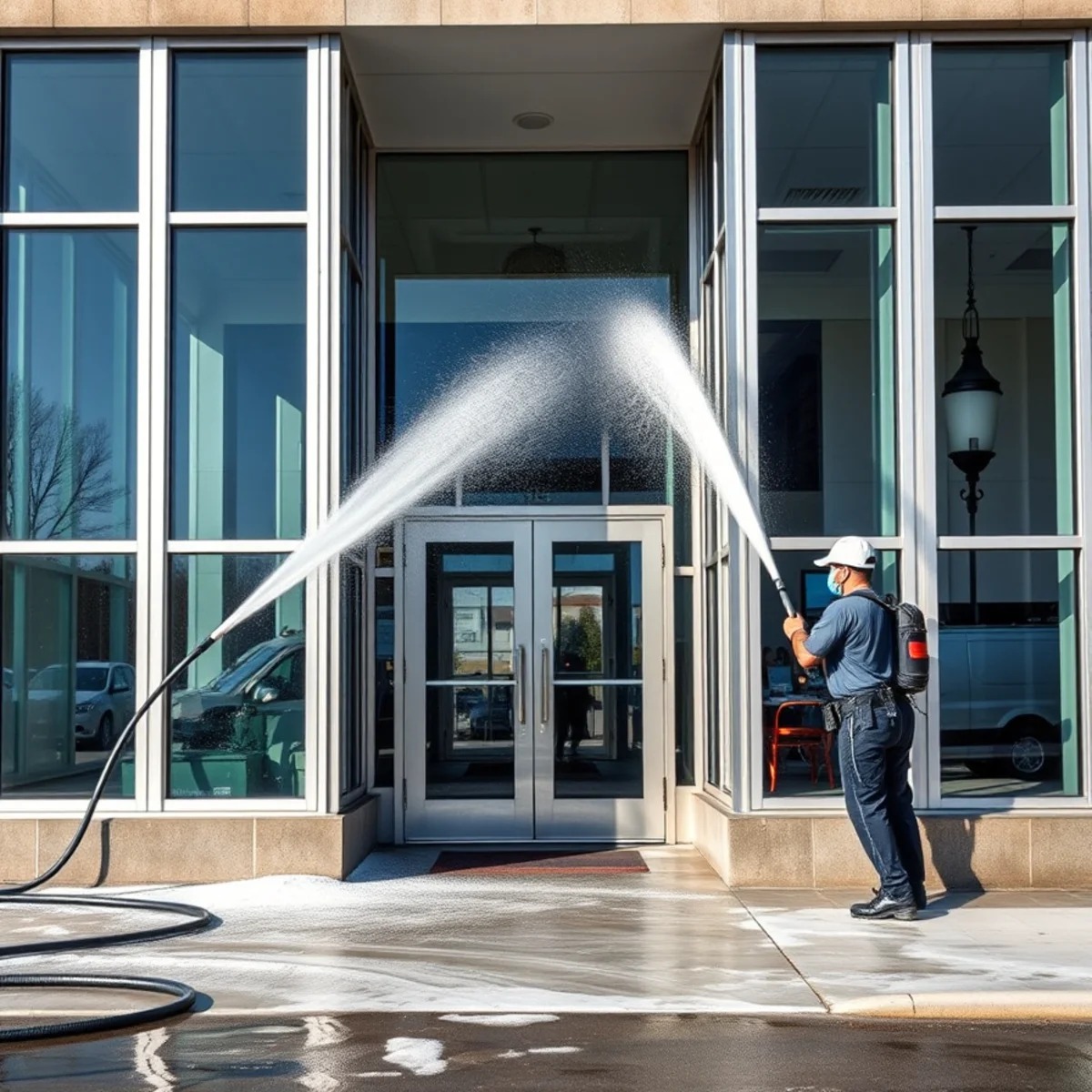
- Surface cleaner pass. Run a rotary surface cleaner in overlapping, even passes across the open pavement. The enclosed spinning jets deliver uniform, streak-free results far faster than a single wand and prevent the wand marks that ruin a job.
- Spot treatment. Hit stubborn oil, gum, rust, and tire marks individually with targeted chemistry and heat. This is where experience separates a clean lot from a mostly-clean one.
- Final rinse and recovery. Rinse loosened grime toward your containment and recovery point, never freely into a storm drain. Squeegee or vacuum-recover the washwater, then let the surface dry before reopening or re-striping.
Equipment and Settings That Get Results
The right machine matters as much as the technique.
- Hot water units. Heated water dramatically improves grease and gum removal and lets you use less detergent. For oil-heavy lots, hot water pressure washing is the difference between lifting a stain and smearing it.
- Pressure (PSI). Commercial lots are typically cleaned in the 2,000–4,000 PSI range. Concrete tolerates the higher end; asphalt is cleaned more conservatively to avoid loosening aggregate or stripping sealant.
- Flow (GPM). Volume does the rinsing. A productive commercial setup runs roughly 2–4 GPM or more — high flow is what makes a large lot finishable in a day.
- Rotary surface cleaners. A hooded surface cleaner is non-negotiable on open pavement. It prevents zebra striping (the "wand marks" or tiger-striping you see when someone cleans a big slab with a single nozzle and misses the overlap).
What causes zebra striping?
Zebra striping happens when a wand's narrow fan leaves clean strips next to dirty ones because the passes do not overlap evenly. A surface cleaner with consistent, overlapping coverage eliminates it. On concrete, uneven dwell time of cleaning solution can also leave light-and-dark banding — another reason even application matters.
Hot Water vs. Cold Water for Oil and Grease Removal
For general dirt and biological growth, cold water plus the correct surfactant is plenty. For oil and grease, gum, and fuel residue, hot water wins decisively. Heat softens petroleum and breaks the bond holding it to the pavement, so a degreaser can do its job and a surface cleaner can flush it away. Cold water tends to emulsify grease only at the surface and push it around, leaving a shadow behind. On restaurant pads, gas stations, and drive-thru lanes, hot water is the right call almost every time.
Massachusetts Stormwater and EPA Wastewater Rules You Must Follow
This is where most contractors — and most DIY attempts — get into trouble. Parking lot washwater carries oil, detergents, sediment, and phosphorus, and letting it run into a storm drain is a regulated discharge, not a convenience.
- Clean Water Act and NPDES. Under the federal Clean Water Act, discharges to waters of the United States are regulated through the National Pollutant Discharge Elimination System (NPDES). Storm drains in Massachusetts generally flow untreated to local rivers, lakes, and the ocean, so washwater that reaches them is reaching a waterway.
- The 2024 Boston-area watershed permit. The EPA has advanced a permit plan covering large impervious properties in the Charles, Mystic, and Neponset watersheds, targeting roughly a 60–65% reduction in phosphorus load. Commercial and industrial sites with about one acre or more of impervious area — parking lots, roofs, and roadways — can fall under Clean Water Act permit requirements. If you manage a large Boston-area lot, this is worth confirming with your environmental consultant.
- MassDEP and your local sewer authority. Surface discharge of washwater is regulated by MassDEP, and detergent- or oil-contaminated washwater may have to be managed as hazardous waste rather than rinsed away. Mass.gov publishes pressure-washing best-management-practice (BMP) guidance worth following. Some municipalities require washwater to go to the sanitary sewer with permission, not the storm system.
- Containment and recovery. A compliant crew plans for this with water containment (berms, drain mats, and dams), a vacuum recovery system to capture washwater, biodegradable detergents, and proper disposal of the recovered water. This is the single biggest reason cutting corners on a commercial lot is a liability, not a savings.
Hiring a fully insured contractor who understands runoff containment protects you from being the property of record when contaminated water hits a storm drain. Our commercial pressure washing crews build containment into the job from the start.
Massachusetts Seasonal Timing
New England gives you a clear calendar if you work with it.
- Spring (the most important clean). Once the freeze season ends, strip the winter's salt, sand, and de-icer residue. This protects asphalt and concrete and removes the slip hazard salt film creates. Spring pollen is also at its peak, so a late-spring wash does double duty.
- Summer. Stay ahead of fresh oil, gum, and weed growth in seams. Spot-treat before stains set, and keep entrances on a tighter cadence.
- Fall (after leaf-drop). Wash after the oaks and maples finish dropping to lift tannin staining and clear leaves out of catch basins before the rains and snow arrive. Clogged drains are the root cause of most ponding and ice.
- Avoid freezing temperatures. Do not deep-wash when temps are near or below freezing — washwater turns to ice and creates exactly the hazard you are trying to prevent. The practical Massachusetts window runs spring through fall.
Flushing buildup out of cracks and expansion joints before winter also reduces freeze-thaw damage, where water seeps into seams, freezes, expands, and pries cracks wider until they become potholes.
Slip-and-Fall Liability and Why a Documented Cleaning Schedule Protects You
A clean lot reduces hazards. A documented cleaning schedule reduces your legal exposure. If a customer slips on an algae patch or a leaf-tannin slick and files a claim, the question your insurer and a court will ask is whether you maintained the property reasonably. Dated service records, before-and-after photos, and a standing maintenance contract are evidence that you did. An undated, reactive, "we clean it when it looks bad" approach is much harder to defend. Treat your cleaning log the way you treat your insurance certificate — proof you took care.
How Parking Lot Cleaning Coordinates With Line Striping and Sealcoating
Cleaning is the prep step that makes everything else stick.
- Clean before re-striping. Paint bonds to clean, dry pavement, not to grime and oil film. Always wash before you re-stripe, or the new lines will fade and peel early.
- ADA marking visibility. Faded ADA-compliant parking symbols, fire lanes, and crosswalks are both a compliance problem and a safety problem. A clean surface lets fresh, high-contrast markings read clearly day and night.
- Sealcoating timing. Asphalt should be clean and dry before sealcoating so the sealer adheres evenly. Coordinating your wash with striping and sealcoating crews saves a mobilization and gets the whole lot done in the right order.
Sweeping vs. Pressure Washing: What Each Removes and Why You Need Both
These are complementary, not interchangeable.
- Parking lot sweeping removes loose, dry material — trash, leaves, sand, gravel, and grit. It keeps the lot tidy, protects drains, and is the necessary first step before any wash.
- Pressure washing removes what is bonded to the surface — oil, gum, tire film, algae, salt residue, and stains. Sweeping will never touch a set-in oil stain.
You need sweeping for routine tidiness and pressure washing for deep cleaning and stain removal. Skipping the sweep before a wash just clogs your recovery equipment and wastes water.
DIY vs. Hiring a Professional Parking Lot Cleaning Company
A consumer pressure washer can handle a single oil spot. An entire commercial lot is a different category of job. Professionals bring commercial rotary surface cleaners that finish acres evenly, hot-water units that actually remove grease, the right chemistry for each stain, and — critically — the containment and vacuum recovery needed to stay legal. They also carry the insurance that matters if equipment damages a vehicle or someone is hurt on a busy property.
For most Massachusetts businesses, a scheduled plan with a professional is more cost-effective than buying equipment, training staff, absorbing the compliance risk, and tying up labor. DIY rarely pencils out once you account for the wastewater rules alone.
How Much Does Parking Lot Pressure Washing Cost in Massachusetts?
Pricing depends on lot size, condition, stain load, and access, so treat the following as general industry estimates, not Wash Bros quotes:
- Per square foot: roughly $0.08 to $0.50 depending on grime level and whether heavy degreasing is needed.
- Per parking space: commonly around $8 to $20 per space for a standard wash.
- Hourly: many commercial jobs price in the $100 to $250 per hour range for a crewed, equipped setup.
- Contract discounts: recurring quarterly or biannual agreements often run 15–30% less than one-off cleanings because mobilization is spread across visits.
The biggest cost drivers are heavy oil and grease (more degreaser, more heat, more time), severe salt or algae buildup, and tight after-hours scheduling. We give a clear, honest quote after walking the property — no fabricated flat rates.
What to Look for in a Commercial Pressure Washing Contractor
Vetting matters more on commercial work than residential. Before you sign, confirm:
- Insurance. Full liability coverage with a certificate of insurance available on request. On a busy lot near vehicles and pedestrians, this is the first box to check.
- Water reclamation capability. Ask directly how they contain and recover washwater. If the answer is "it just rinses away," keep looking — that is a compliance liability they are handing to you.
- References and local track record. Commercial references and reviews from properties like yours.
- After-hours and off-peak scheduling. A good contractor works around your operating hours so the lot is closed off safely without killing your business day.
Preparing Your Lot and Tenants for a Wash
A smooth wash needs a clear lot and a little notice.
- Give notice. Post signs and email tenants 24–48 hours ahead so vehicles are moved.
- Plan car removal. Sectioning the lot lets the crew clean in zones while keeping part of it open. A fully empty lot is fastest and cleanest.
- Schedule off-hours or a short closure. Early mornings, evenings, or off-peak days minimize disruption and let the surface dry before reopening. Restaurants and retail usually do best with overnight or pre-open windows.
Industry-Specific Considerations
Every property type has a pressure point worth naming.
- Retail centers and plazas. High traffic and high visibility. Entrances, cart corrals, and walkway transitions show wear first; quarterly service keeps the whole center looking maintained.
- Restaurants. Grease at entries and especially dumpster pads demands hot water and degreaser. Pads left dirty draw pests and odor. Pair lot work with restaurant pressure washing for the building and equipment areas.
- Gas stations. Fuel and oil residue across fueling areas, plus strict expectations around containment near drains.
- Medical offices. Clean, slip-safe walkways and ADA markings are essential for an older, mobility-limited patient base.
- Apartment complexes and HOAs. Shared lots, resident scheduling, and shaded areas prone to algae. Recurring plans keep common areas presentable and reduce board complaints, often bundled with HOA pressure washing.
- Office parks. Lower turnover but large footprints; biannual deep cleans plus entry spot service usually suffice.
We clean commercial lots across Eastern and South Shore Massachusetts, from MetroWest towns like Framingham to the South Shore and Worcester County.
Keep Your Lot Clean, Safe, and Compliant with Wash Bros
A clean parking lot protects your investment, keeps visitors safe, gives you the documentation to defend against liability claims, and tells everyone who pulls in that your business handles the details. Wash Bros is a fully insured exterior cleaning company founded in 2023 by brothers Louis and Dominic, with a 5.0 average across 130 Google reviews, biodegradable cleaning solutions, and runoff containment built into every commercial job.
Ready to put your lot on a schedule that keeps it presentable and compliant year-round? Contact us for a free estimate or call +1 (351) 242-0666. We will walk the property, recommend the right cadence, and give you a clear, honest quote — one-time or ongoing.
Frequently Asked Questions
Need Professional Exterior Cleaning?
Wash Bros provides affordable, dependable pressure washing across Massachusetts. Get your free estimate today.
Get a Free Estimate