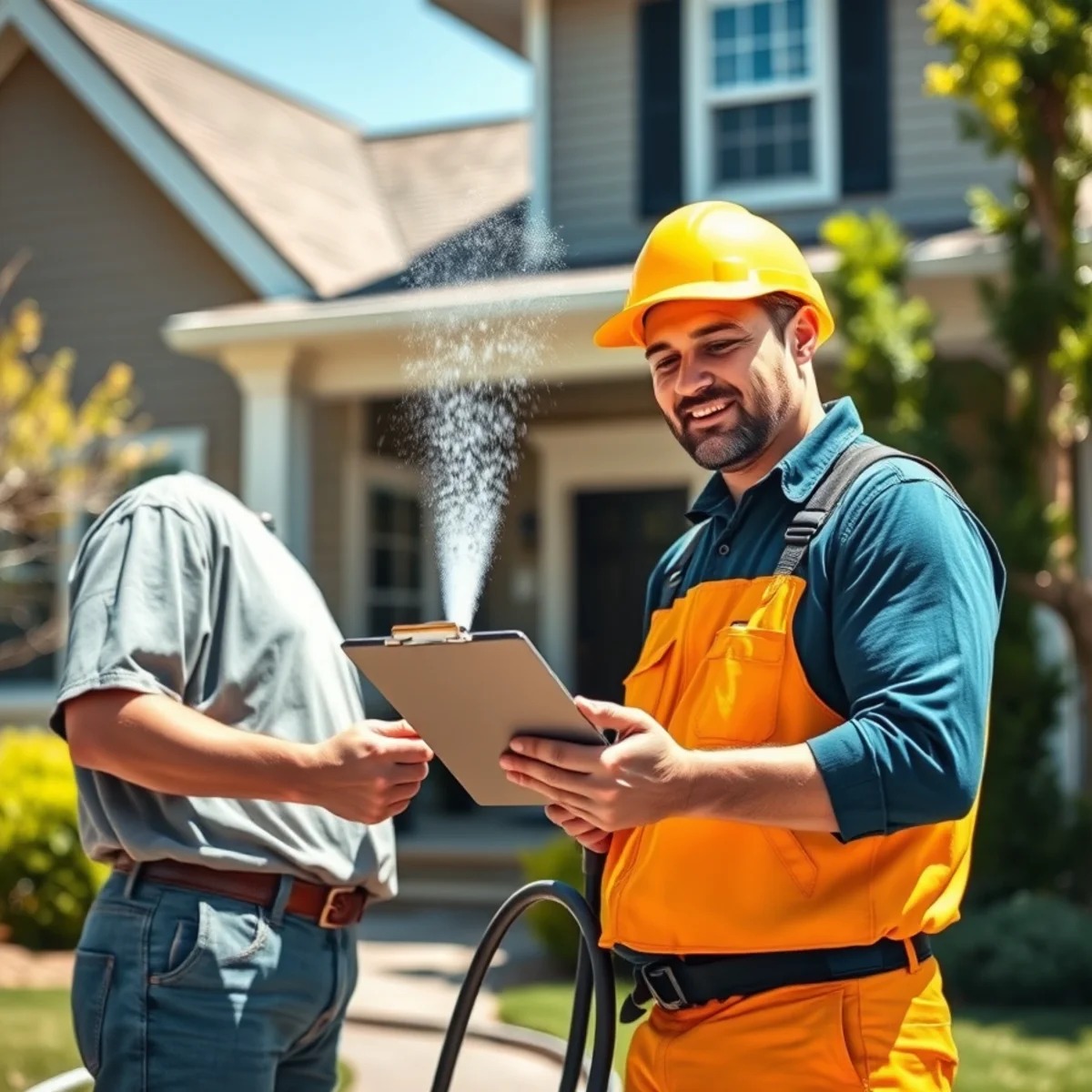
The exact questions to ask before hiring a Massachusetts pressure washing contractor, with red flags, how to verify insurance and HIC registration, and a checklist.
Hiring the wrong pressure washing contractor can mean stripped paint, etched concrete, water driven behind your siding, or simply paying twice for a job done right the second time. The good news: a short list of pointed questions, asked before any water touches your house, separates seasoned pros from weekend operators with a rented machine. This Massachusetts-specific guide gives you the exact questions, why each answer matters, and what a trustworthy local company should say back.
Why the Questions You Ask Matter More Than the Price Quote
Exterior cleaning looks simple from the curb. It is surprisingly easy to get wrong. Too much pressure on vinyl siding forces water behind the panels. The wrong nozzle on a roof blasts off asphalt granules and voids the shingle warranty. A driveway cleaned unevenly leaves permanent "zebra stripes." In New England, where freeze-thaw cycles, salt-air corrosion, humidity, and pollen already stress every surface, careless work compounds damage you will pay to repair.
The contractors who do this well welcome questions. The ones cutting corners get vague, dodge specifics, or push you to sign on the spot. Treat the conversation itself as your first quality test. The lowest quote on the block is often the most expensive once you add up the redo and the repairs.
A note on the key idea behind everything below: you don't need more pressure, you need the right chemistry. Pressure does not kill algae or mold at the root. Biodegradable surfactants and the correct detergents do. A contractor who understands that distinction is already ahead of most.
Question 1: Are You Licensed and Registered to Work in Massachusetts?
Massachusetts does not issue a specific "pressure washing license," but most exterior work tied to a home falls under the state's Home Improvement Contractor (HIC) registration program. HIC registration costs the contractor a modest fee, funds a consumer Guaranty Fund, and gives you recourse if a registered contractor leaves a job unfinished or botched.
Ask directly whether the company carries HIC registration and a Massachusetts business registration. A legitimate operator shares credentials without flinching. If the work is purely surface cleaning with no structural component, registration requirements can vary, but the willingness to discuss credentials honestly tells you a lot about who you are dealing with.
Wash Bros is a local, family-run, fully insured Massachusetts company. We are happy to walk you through our credentials and provide proof of insurance on request so you can hire with confidence.
Question 2: Are You Fully Insured? And Can I See a Certificate?
This is the non-negotiable question, and "yes" over the phone is not enough. Ask for a certificate of insurance (COI) and confirm two coverages:
- General liability insurance covers property damage. If a wand cracks a window, etches a stone walkway, or floods a basement window well, this is what pays for it instead of you.
- Workers' compensation insurance covers injuries to the crew. People climb ladders and walk roofs on your property. Without workers' comp, an injured worker's medical bills can become your problem through a homeowner's claim.
Ask the contractor to have the insurer email a COI listing you, the homeowner, as a certificate holder. That single step weeds out most fly-by-night operators, because the genuinely uninsured cannot produce one. Property damage liability is the difference between a quick repair call and a lawsuit. Wash Bros is fully insured and provides a certificate of insurance on request.
Question 3: How Long Have You Been in Business, and What's Your Experience With Homes Like Mine?
Years in business matter, but relevance matters more. A crew that has cleaned hundreds of homes exactly like yours is worth more than a generalist with a longer résumé.
Ask whether they regularly handle your specific situation: a cedar-shingled colonial, a three-story Victorian with delicate trim, aged vinyl siding prone to oxidation, or a brick historic home. New England housing stock has quirks, and the right approach for a 1920s painted clapboard is not the right approach for new construction.
Wash Bros is a local company founded in 2023 by brothers Louis and Dominic. We hold a 5.0 rating across 130 reviews, and we clean the full range of Massachusetts homes, from coastal properties fighting salt-air corrosion to inland homes battling pollen and algae.
Question 4: Do You Pressure Wash or Soft Wash, and How Do You Decide Which to Use?
This question reveals competence faster than any other. A skilled pro matches the method to the material instead of blasting everything at full power.
- Pressure washing (high PSI) suits hard, durable surfaces: concrete driveways and sidewalks at roughly 2,000 to 3,000 PSI, some masonry, and heavy-grime hardscape.
- Soft washing uses low pressure plus specialized cleaning solutions to safely treat delicate surfaces. It dwells, kills organic growth at the root, then rinses, rather than blasting the surface.
Correct, surface-safe PSI ranges a knowledgeable contractor should know:
| Surface | Approximate safe range |
|---|---|
| Asphalt shingle roof | Soft wash, under 100 PSI |
| Vinyl siding | 100–500 PSI |
| Cedar / wood siding | Under 200 PSI |
| Historic brick | Under 400 PSI |
| Stucco / EIFS | Under 150 PSI |
| Composite deck | 500–1,000 PSI |
| Metal roof | 500–800 PSI |
| Concrete driveway | 2,000–3,000 PSI |
If you have asphalt shingles, the answer for roof cleaning should always be soft washing. Anyone proposing to power-wash your shingles is telling you they will damage them. The same caution applies to vinyl siding cleaning, where too much pressure cracks panels and drives water into the wall cavity. A good contractor walks your property, names each surface, and explains the method for each one.
Question 5: What Cleaning Solutions Do You Use, and Are They Safe for Pets, Plants, and Landscaping?
Because the chemistry does the real work, you deserve to know what is going on your house. Most professional soft-wash solutions are built around sodium hypochlorite (the active agent that kills algae, mold, and mildew) combined with a surfactant that helps the solution cling and lift grime. Applied at the correct dilution and rinsed properly, these are safe and effective.
Ask these follow-ups:
- Are your detergents biodegradable, and how do you protect my landscaping? A careful crew pre-soaks shrubs and beds with plain water before application and rinses them again afterward, diluting any runoff. This pre-soak and runoff awareness is the mark of a pro, not an afterthought.
- Do you pre-treat, dwell, and rinse, or just spray and go? Quality cleaning is a process. Letting the solution dwell means less pressure is needed, which means less risk to your surfaces.
- Are you mindful of well water and drainage? Many MA homes run on private wells, and a contractor should account for where rinse water goes.
For grease-heavy or commercial surfaces, ask about hot water pressure washing, which cuts oil far better than cold water alone.
Question 6: How Will You Protect My Property, Windows, Plants, and Fixtures?
Thoughtful prep is the quiet signal of a careful crew. Ask what they do before the trigger gets pulled:
- Pre-soaking and, where needed, covering plants and delicate beds.
- Closing and protecting windows, and being mindful of older glazing and screens.
- Covering or avoiding electrical outlets, light fixtures, and outdoor receptacles.
- Moving or working around furniture, grills, and décor.
A contractor who shrugs at this question is telling you they will discover the hard way that water gets everywhere. Wash Bros treats landscaping protection and careful prep as standard, not an upsell.
Question 7: What Training and Certifications Do Your Technicians Have?
Anyone can buy a machine at a big-box store. Knowing how to read a surface, choose a nozzle, mix a dilution, and avoid damage takes training. Ask how technicians are trained, whether there is hands-on mentoring, and whether the crew that shows up has done your type of job before. You are not looking for a wall of certificates so much as evidence that the people holding the wand know what they are doing.
Question 8: What Equipment Do You Use?
Equipment quality affects both results and safety. Ask whether they run commercial-grade equipment rather than a consumer machine, and have them speak to two specs in plain terms:
- PSI (pounds per square inch) is the force. More is not better. The skill is dialing it down with the right nozzle and tip for each surface.
- GPM (gallons per minute) is the flow that does the rinsing and carries grime away. Professionals often value good GPM as much as high PSI.
Ask whether they offer hot water for grease and gum, which cold-water machines struggle with. The right answer is rarely "maximum pressure." It is the right tip, the right flow, and the right detergent for the job.
Question 9: Can You Provide References, Reviews, and Before-and-After Photos?
Experience should be verifiable, not just claimed. Two simple requests separate established companies from newcomers:
- Reviews. Look for a strong Google reviews rating backed by a meaningful number of reviews, and read the detailed ones. Check BBB accreditation if it matters to you. Wash Bros holds a 5.0 average across 130 reviews. Reviews from neighbors in your own region carry extra weight, because that contractor has already proven they handle local conditions.
- Before-and-after photos. Ask to see results on work like yours, whether a stained driveway, a streaked roof, or a commercial storefront. Real companies have a portfolio. If a contractor cannot show a single photo of past work, that is a flag.
Question 10: How Do You Price the Job, and Is the Quote Written and All-Inclusive?
Pricing is where surprises hurt most, so get clarity up front. Be cautious of any firm number quoted sight unseen over the phone. Accurate pricing depends on square footage, surface type, level of soiling, and access. Most reputable companies price by square foot, by surface, or as a flat rate after seeing the property.
A fair, complete written estimate should itemize:
- Every surface and service included (and what is not included).
- The method for each surface.
- What could change the price, such as heavy moss or oil stain removal needing extra treatment.
- The total, payment terms, and any deposit.
Insist on getting it in writing. A verbal "ballpark" is not a quote. And be wary of a bid far below every other estimate, which usually signals an uninsured operator, rushed work, or surfaces left half-finished.
Question 11: Do You Offer a Satisfaction Guarantee or Warranty?
Ask what happens if you are not happy with a spot, or if something gets damaged. A confident contractor stands behind the result and will come back to make a missed area right. Ask specifically: if a surface is damaged, does their liability insurance cover the repair? (This circles back to Question 2.) A contractor who is satisfaction-focused and fully insured gives you two layers of protection. Wash Bros is satisfaction-focused and will work with you to make the result right.
Question 12: Who Will Actually Do the Work, Employees or Subcontractors?
Many question-list articles skip this one. Ask whether the crew is made up of the company's own employees or subcontractors, and whether someone experienced supervises the job. This matters for accountability and for insurance: workers' comp coverage can get murky with subcontractors. You want to know who is standing on your roof and who answers for the result. Wash Bros is a hands-on, family-run operation, so you are dealing with the people who own the work.
Question 13: How Do You Handle Scheduling and Weather Delays in New England?
The Massachusetts season is short. Exterior cleaning runs roughly spring through fall, with freeze risk shutting things down in winter. Soft-wash solutions and rinse water do not perform well in the cold, and standing water in a hard freeze can damage surfaces. That compressed window matters:
- Book early. The best contractors fill up fast in late spring and early summer.
- Expect rain delays, and ask how they reschedule them. A flexible, communicative contractor beats one who vanishes after a postponement.
- Time the work right. House washing often lands best in late May through June, after pollen drops. Decks are frequently a better fit for early fall, and concrete sealing before road-salt season.
A local contractor builds this rhythm into the schedule. An out-of-area crew passing through after a storm usually does not.
Question 14: What Is Your Payment Policy and Deposit Requirement?
Ask how and when you pay, and whether a deposit is required. A modest deposit to hold a date is normal. What is not normal: a demand for full payment in cash before any work is done. As a general benchmark, be comfortable with a reasonable deposit and the balance on satisfactory completion. Refuse full-cash-upfront and cash-only operators. A real business takes multiple payment methods and gives you a receipt.
One more protection worth knowing: under Massachusetts consumer law, door-to-door and in-home sales over $25 generally come with a three-business-day right to cancel (the cooling-off period), and home improvement contracts are required to include that cancellation notice in writing. If a salesperson pressures you to sign and pay on the spot, that pressure is itself the red flag.
Red Flags to Watch For
Most question-list articles bury these. Here they are plainly. Walk away if you see:
- Lowball quotes, like a $50 "whole-house" special. The math does not work for an insured crew doing the job right.
- Cash-only or full payment demanded upfront.
- No written estimate, or refusal to put the scope in writing.
- No proof of insurance, or "we're covered, trust me."
- High-pressure or door-to-door sales with "today only" urgency.
- No reviews, no references, no photos of past work.
- Pressure washing proposed for a roof or delicate siding.
- Vague answers about chemistry, PSI, or how they protect landscaping.
Any one of these is reason to slow down. Two or more, and you keep looking.
How to Verify a Contractor's Credentials in Massachusetts
Do not just take their word for it. Verifying takes a few minutes:
- Check HIC registration. Use the Massachusetts HIC lookup maintained by the Office of Consumer Affairs (services.oca.state.ma.us/hic) to confirm a contractor's registration and standing.
- Get the certificate of insurance. Ask the insurer to email a COI naming you as certificate holder. Confirm both general liability and workers' comp are active.
- Read the reviews yourself. Search the company on Google and, if it matters to you, the BBB. Look at the number of reviews and the substance, not just the star count.
- Confirm the written contract includes the scope, price, payment terms, and, for in-home signings, the three-day cancellation notice.
A trustworthy contractor not only allows this, they expect it.
Why Local Massachusetts Experience Matters
New England grime is specific, and so is the right response. Coastal homes fight salt-air corrosion; inland homes battle humidity, pollen, and the black streaks of Gloeocapsa magma algae spreading across north-facing roofs. Moss and lichen take hold on shaded shingles and cedar. Freeze-thaw cycles spall brick, crack mortar joints, and lift decking, which means timing and technique have real consequences here.
A local contractor knows which stains are which, which season suits which surface, and how to protect a historic colonial or brick facade. Wash Bros serves communities across the state, from Boston and Cambridge through MetroWest and out to Worcester. That local presence is the difference between a contractor who understands your house and one just passing through.
Printable Checklist: Questions to Ask Before You Hire
Copy or print this and check every box before you sign:
- Are you fully insured (general liability + workers' comp), and can I see a certificate?
- Are you HIC-registered / registered to work in Massachusetts?
- How long have you done this, and have you cleaned homes like mine?
- Do you soft wash roofs and delicate siding, not pressure wash them?
- What cleaning solutions do you use, and are they safe for pets and plants?
- How will you protect my windows, landscaping, and fixtures?
- What equipment do you run, and is it commercial-grade?
- Can you show reviews and before-and-after photos of similar jobs?
- Is the quote written, itemized, and all-inclusive?
- Do you stand behind the work if I'm not satisfied?
- Who does the work, employees or subcontractors, and who supervises?
- How do you handle weather delays and scheduling?
- What is the deposit, and what are the payment terms?
Sail through this list, and you are almost certainly in good hands. Stumble on the basics, and keep looking.
Get a Free, No-Pressure Quote From Wash Bros
You should never have to guess whether your exterior cleaner is qualified. At Wash Bros, founded in 2023 by brothers Louis and Dominic, we welcome every one of these questions, because answering them honestly is how we earned a 5.0 rating across Massachusetts. We are fully insured with a certificate of insurance on request, we match the method to the surface, and we put the quote in writing. Request your free, no-pressure estimate today through our contact us page or call +1 (351) 242-0666. We will walk your property, recommend the right method for each surface, and give you a clear quote, so you can hire with confidence.
Frequently Asked Questions
Need Professional Exterior Cleaning?
Wash Bros provides affordable, dependable pressure washing across Massachusetts. Get your free estimate today.
Get a Free Estimate