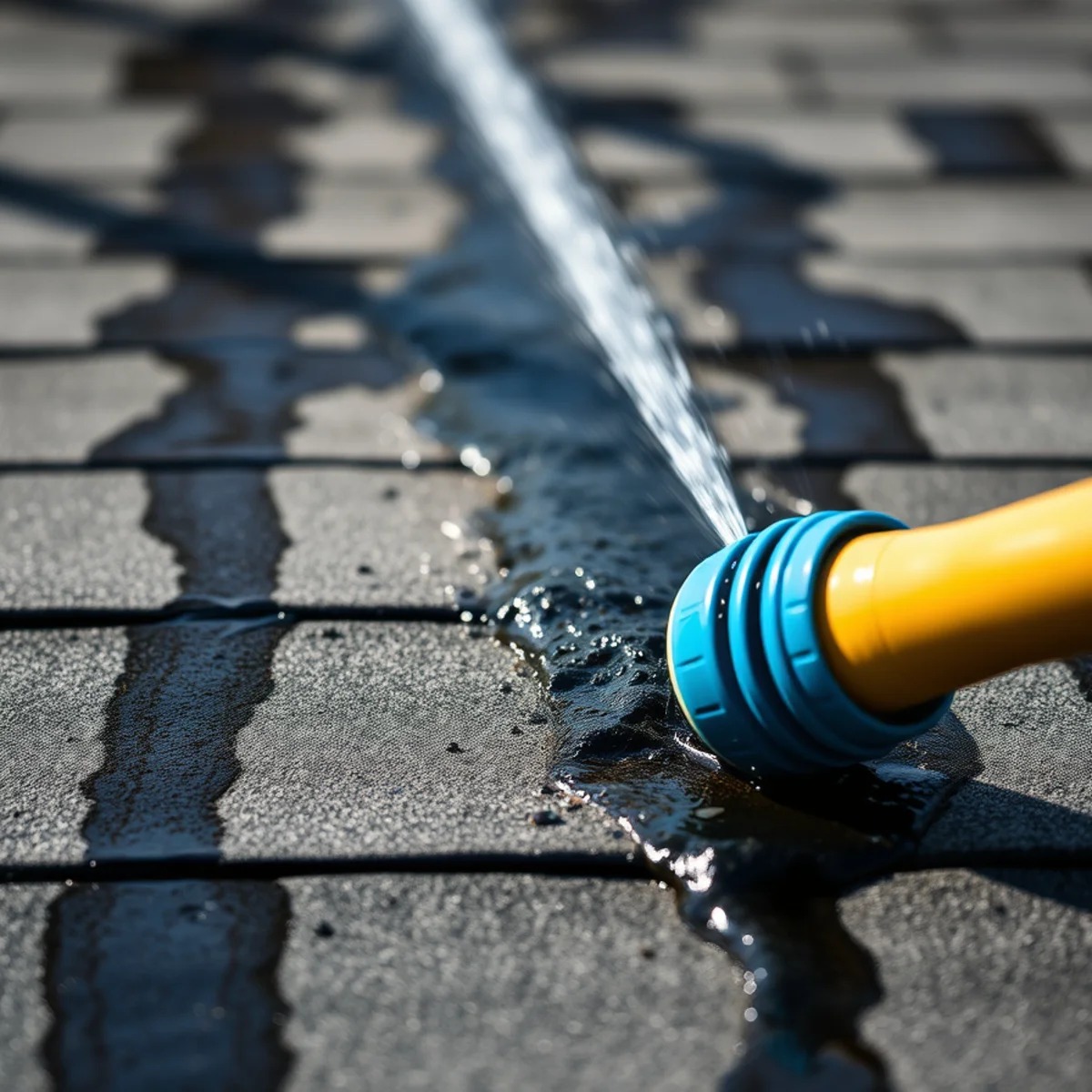
Those black streaks running down your roof are a living blue-green algae feeding on your shingles. Here is what causes them and how to remove them safely.
Those dark streaks bleeding down your roof from the ridge to the gutters are not dirt, soot, or worn-out shingles, even though they look like all three. They are a living organism that is slowly feeding on your roof. This guide explains exactly what causes black streaks on Massachusetts roofs, the biology behind why they form, how to remove them without wrecking your shingles, and how to keep them from coming back.
Quick Answer: What Black Streaks on a Roof Actually Are
Black streaks on a roof are colonies of a blue-green algae called Gloeocapsa magma. It is not mold, not mildew, not a chimney stain, and not "old shingles." It is organic growth, a living cyanobacteria that lands on your roof as airborne spores, takes hold, and feeds on the materials in your asphalt shingles. The streaking pattern happens because rain washes the algae and its spores downhill, dragging the colony from the ridge toward the gutter line. If your roof looks worse on one side, that is usually the north-facing or shaded slope, which stays damp longer. The good news: black algae streaks are removable, and with the right approach they stay gone for years.
What Causes Black Streaks on Roofs? (Gloeocapsa Magma Algae)
The single cause of those classic vertical black streaks is Gloeocapsa magma, a hardy species of blue-green algae (technically cyanobacteria). It travels through the air as microscopic spores. When those spores land on a roof that stays damp long enough, they germinate, anchor into the shingle surface, and begin to multiply into a visible colony.
Three conditions let the colony thrive:
- Moisture. Humidity, dew, fog, and slow-drying shingles give the algae the water it needs.
- A food source. Modern shingles contain a filler the algae can digest (more on that below).
- Spores in the air. Once one roof in a neighborhood is colonized, wind and rain carry spores to every roof nearby. This is why black streaks tend to spread down an entire street.
That last point matters in dense Massachusetts neighborhoods. If your neighbor's roof is streaked, your roof is being seeded with spores every time the wind blows. Black streaks are not a sign you did anything wrong. They are a sign your roof sits in a climate and a neighborhood where this algae spreads easily.
The Science: How Algae Feeds on Limestone Filler in Asphalt Shingles
Here is the part most articles skip, and it explains why this problem exploded in the first place.
Older asphalt shingles used inert fillers. Starting in the 1980s and 1990s, manufacturers began blending crushed limestone, which is calcium carbonate, into the shingle as a low-cost filler and weight additive. Limestone made shingles cheaper to produce and helped them lie flat. It also, unintentionally, handed Gloeocapsa magma a buffet.
The algae digests the calcium carbonate (limestone filler) embedded in and around the ceramic granules on the shingle surface. In effect, the algae is literally eating part of your roof. As it consumes that filler and spreads its colony, it loosens the bond holding the protective granules in place, which contributes to granule loss over time. So the streaks are not just sitting on top of the shingle like dust. The organism is anchored into the surface and feeding on it.
This is also why a quick rinse never works for long. If you only wash off the visible black layer but leave the living colony anchored in the granules, it regrows. The growth has to be killed at the source, not just rinsed off the surface.
Why the Streaks Look Black (UV-Protective Sheath) When the Algae Is Blue-Green
People are often surprised to learn the organism is blue-green algae when the stains are clearly black. The color change is the algae protecting itself.
As the colony grows and is exposed to sunlight, the cyanobacteria produce a dark, pigmented outer coating, a UV-protective sheath, almost like the organism putting on sunscreen. That dark sheath shields the colony from ultraviolet damage and helps it retain moisture during dry spells. The byproduct is the black or charcoal-gray color you see from the street.
So the black you are looking at is not soot or staining. It is the sun-shielding armor of a living thing. That same sheath is what makes the streaks so stubborn and so durable. It is built to survive sun, heat, and drought, which is exactly why it shrugs off a casual hose-down.
Why Streaks Run Vertically From Ridge to Gutter (Gravity + Rain)
The vertical, dripping streak pattern is pure gravity and water flow.
Algae often establishes first near the ridge, where dew settles and certain roof components hold moisture. Every time it rains, water runs down the slope and carries loose algae cells and spores with it, spreading the colony downhill in long vertical runs from the ridge toward the gutters. The streaks follow the path the water takes.
You will also notice streaks are heavier below roof penetrations, valleys, and anywhere water concentrates and runs slowly. Those are the spots that stay wet longest after a storm, giving the algae more time to feed and spread. The pattern is a map of how water moves across your roof.
Why Black Streaks Appear on North-Facing and Shaded Roof Slopes First
One of the most common questions homeowners ask is why only one side of the roof is streaked. The answer is sun exposure.
In Massachusetts, north-facing slopes get the least direct sunlight throughout the day. They dry slowest after rain and dew, stay cooler, and hold moisture far longer than south- or west-facing slopes. That damp, shaded environment is exactly what Gloeocapsa magma needs, so the north-facing roof and any heavily shaded slope almost always streak first and worst.
The same logic applies to any slope shaded by tall trees, a neighboring house, or a dormer, regardless of compass direction. If part of your roof sits in shade most of the day, that section will stay damp and colonize before the sunny sections do. So when one side of your roof looks filthy and the other looks nearly clean, you are not imagining it. You are seeing the difference between a slope that dries quickly and one that never gets the chance.
Black Streaks vs. Moss vs. Lichen vs. Mold: How to Tell the Difference
Black streaks rarely travel alone. In our climate they often share a roof with moss and lichen, and homeowners frequently confuse all of them. Knowing which one you are looking at helps you understand the threat and the right treatment.
| Growth | What it looks like | Texture | Main risk |
|---|---|---|---|
| Algae (Gloeocapsa magma) | Flat black or dark gray vertical streaks | Smooth, lies flush with the shingle | Cosmetic plus slow granule loss |
| Moss | Green, fuzzy, clumping mounds in shingle seams and shaded edges | Thick, spongy, three-dimensional | Holds water, lifts shingle edges, freeze-thaw damage |
| Lichen | Crusty gray-green or white patches, sometimes with a branching look | Hard, tightly bonded to the surface | Most stubborn; roots into granules |
| Mold / mildew | Patchy, often near gutters or under debris; can have a musty smell | Slimy or powdery | Indicates trapped moisture and poor drainage |
The quick field test: if it is a flat streak you could not grab with your fingers, it is algae. If it is a green mound you could scoop, it is moss. If it is a hard crusty patch fused to the shingle, it is lichen. A roof showing all three at once is completely normal in shaded New England neighborhoods. Our moss and lichen removal and algae removal services are built to clear all of them in one visit, not just the part you can see most easily.
Are Black Streaks Bad for Your Roof? Granule Loss, Moisture Retention & Shortened Lifespan
It is tempting to file roof streaks under "purely cosmetic." That is only half true. Algae on its own is mostly a curb-appeal problem in the short term, but left for years, the organic growth and its companions quietly shorten a roof's life.
Here is what actually happens over time:
- Granule loss. As the algae feeds on the limestone filler binding the ceramic granules, and as lichen roots into the surface, those protective granules loosen and shed. Granules are the shingle's sunscreen. Lose them and the asphalt underneath ages and dries out faster.
- Moisture retention. The dark colony and any moss alongside it hold dampness against the shingles instead of letting them dry. Persistent moisture retention is the enemy of any roof.
- Freeze-thaw damage. This is the Massachusetts killer. Trapped moisture freezes in winter, expands, and works at the shingle through repeated freeze-thaw cycles, lifting edges and opening gaps. Moss makes this dramatically worse because it acts like a sponge.
- Heat absorption. A black-stained roof absorbs more sunlight than a clean one, which can nudge attic temperatures and summer cooling costs upward.
- Shortened roof lifespan. Put it together, accelerated granule loss plus trapped moisture plus freeze-thaw stress, and you get a roof that reaches the end of its service life early. Premature roof replacement is a five-figure expense; a soft wash is a tiny fraction of that.
For the protective side of this in more depth, see our companion guide on why roof cleaning is important for Massachusetts homes.
Do Black Streaks Cause Leaks or Lower Home Value? (Curb Appeal & Insurance Inspections)
Do black streaks cause leaks? Not directly, and not on their own. Algae streaks alone will not put a hole in your roof. The leak risk comes from the company they keep, moss lifting shingle edges and freeze-thaw cycles opening seams, which can eventually let water in. So streaks are best understood as an early warning that conditions on your roof favor the kind of growth that does cause damage.
The bigger near-term costs are about perception and money:
- Curb appeal and home value. A blotchy, streaked roof makes an otherwise well-maintained home look neglected and older than it is. To a buyer pulling into the driveway, a dirty roof reads as "deferred maintenance," and that impression forms before they reach the front door. A clean roof is one of the highest-impact things you can fix from the curb.
- Insurance and drive-by inspections. This is the one Massachusetts homeowners underestimate. Insurers increasingly use drive-by inspections and aerial imagery to assess roofs. A heavily algae-streaked or moss-covered roof can be flagged as "neglected" or near end-of-life, which in some cases leads to non-renewal notices or demands for a roof replacement. A clean roof simply does not draw that scrutiny.
- Shingle warranty. Some manufacturers expect reasonable maintenance. A roof left to deteriorate under heavy growth can complicate a warranty claim down the road.
Why Black Streaks Are So Common on Massachusetts & New England Roofs
New England hands Gloeocapsa magma almost everything it wants. Several local factors stack up:
- Humid summers, wet shoulder seasons. Our humid summers plus steady spring and fall rain keep roofs damp for long stretches. Moisture is the number-one driver of algae.
- Snowy, freeze-thaw winters. Snow sits on roofs and melts slowly, and the freeze-thaw cycle keeps surfaces wet while also stressing the shingles, a double hit.
- Heavy tree cover. From the shaded, mature-tree streets of Newton and Needham to wooded lots across MetroWest, Worcester County, and the South Shore, overhanging branches keep roofs in shade and drop debris that traps moisture.
- Coastal humidity and salt air. Along the North Shore, South Shore, and Cape, persistent humidity and salt air keep roofs damp and feed organic growth on waterfront and coastal homes.
Add it up and black streaks are close to a universal New England roof problem, not a sign of a bad roof or a careless owner. If your home sits under trees or near the water, it is a question of when, not if.
How to Remove Black Streaks From a Roof Safely (Soft Washing, the ARMA-Recommended Method)
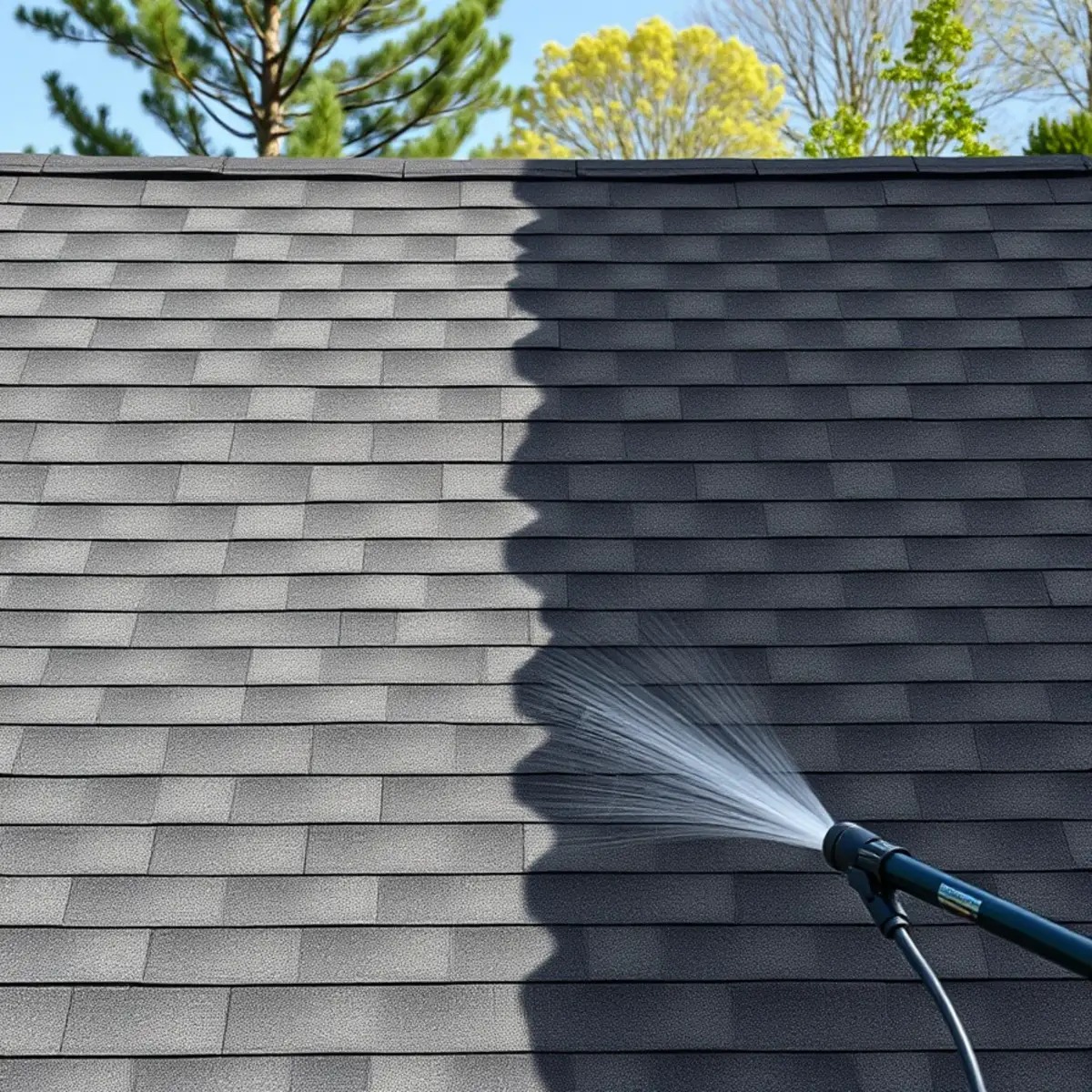
The correct, roof-safe way to remove black streaks is soft washing: low pressure paired with the right cleaning chemistry. This is not a fringe opinion. The Asphalt Roofing Manufacturers Association (ARMA), the trade body for the shingle industry, specifically warns against high-pressure washing of shingles and recommends a low-pressure approach using a cleaning solution to remove algae and let it rinse and dwell rather than blasting it off.
The principle behind it is simple, and it is the single most important idea in this whole article: you don't need more pressure; you need the right chemistry. Pressure does not kill algae. It just knocks off the visible top layer while damaging the shingle, and the living colony regrows. The right cleaning solution kills the organism at the root, so the streaks leave and stay gone far longer.
Asphalt shingles should be cleaned at well under 100 PSI, essentially a gentle rinse, never the 2,000-plus PSI you would use on a concrete driveway. The cleaning solution does the work; the low pressure just carries the dead growth away.
Why You Should Never Pressure Wash Asphalt Shingles
It feels intuitive that more pressure equals a cleaner roof. With shingles, the opposite is true, and the damage can be expensive.
High-pressure washing on asphalt shingles:
- Blasts off the protective granules, the exact ceramic layer that shields the asphalt from UV. Once they are gone, they do not come back, and the shingle ages fast.
- Forces water up under the shingles, where it can soak the decking and cause the leaks you were trying to avoid.
- Voids many shingle warranties, because manufacturers explicitly prohibit high-pressure cleaning.
- Strips off the very layer that fights algae on AR shingles (more on those below), making future growth worse.
A determined afternoon with a rented pressure washer can do thousands of dollars of damage to a roof that was otherwise fine. If you take one thing from this article: never aim a pressure washer at your shingles. For the fuller breakdown of where each method belongs, see pressure washing vs soft washing.
DIY Roof Cleaning: Bleach/TSP Mixes, Wet & Forget, Oxygen Bleach (and Their Risks)
Plenty of homeowners try to handle streaks themselves. Here is an honest rundown of the common DIY routes and their real drawbacks.
- 50:50 bleach and water mix. This is the classic. A roughly 50:50 bleach and water mix (sodium hypochlorite diluted with water), applied, given dwell time to kill the algae, then gently rinsed, is essentially the homeowner version of the ARMA method. It works. The catch is application: you are on a wet, slippery roof, the runoff can scorch landscaping and reach well water if it is not controlled, and bleach fumes and splash are hard on you, your gutters, and metal flashing without proper handling.
- TSP (trisodium phosphate). Sometimes added to boost cleaning. It is harsh, phosphate runoff is an environmental problem (and restricted in many places), and it does not change the core safety issue of being up on the roof.
- Wet & Forget and similar no-rinse roof treatments. These are no-rinse roof treatments you spray on and let the weather do the rest over weeks or months. They are gentle and genuinely useful for light, early growth and for slowing regrowth, but they are slow, and on heavy streaks or established lichen they underperform.
- Oxygen bleach (sodium percarbonate). A more landscaping-friendly alternative to chlorine bleach. It is gentler on plants but generally weaker on heavy Gloeocapsa magma, and it still leaves you doing the dangerous part yourself.
The chemistry is not the hard part. The roof is. The most underrated risk of DIY roof cleaning is the ladder and the slope, and the second is unprotected runoff hitting gardens, lawns, and groundwater. Before any solution is applied, plants should be pre-soaked and runoff managed, something we build into every job.
How Professional Soft Washing Works (Sodium Hypochlorite + Surfactants, Low Pressure)
A professional soft wash takes the chemistry that works and adds the control, safety, and consistency that DIY can't match.
The process, in plain terms:
- Pre-soak and protect. Surrounding plants, shrubs, and lawn are pre-soaked with water so any overspray is diluted, and runoff is managed, especially important on properties with well water.
- Apply the cleaning solution. A measured blend of sodium hypochlorite and surfactants is applied at low pressure. The surfactants help the solution cling to the slope, penetrate the algae's protective sheath, and stay wet long enough to work, instead of running straight off.
- Let it dwell. The solution is given proper dwell time to kill the Gloeocapsa magma, moss, and lichen down to the root. This is the step that makes results last. The growth is killed, not just rinsed.
- Gently rinse or let it weather. Depending on the situation, the dead growth is rinsed away at low pressure or left to weather off, leaving the granules untouched.
We use biodegradable surfactants, surface-appropriate dilutions, and roof-safe low-pressure cleaning so the shingles, the warranty, and your landscaping all come through fine. This is the exact approach behind our soft washing and roof cleaning services across Massachusetts, from older homes in Worcester to coastal properties around Quincy and the South Shore.
How to Prevent Black Streaks From Coming Back
A clean roof is not a permanent state, but smart prevention dramatically slows regrowth. None of these is a silver bullet alone; together they work.
Zinc & Copper Strips: How Metal Ions Stop Algae
Install thin zinc strips or copper strips along the ridge, just under the top course of shingles. Every time it rains, water washes trace metal ions down the slope. Those ions are toxic to algae, so the surface below the strip stays largely streak-free. You can often spot this effect on existing roofs: the clean stripe of shingle directly below a metal chimney or flashing is metal ions at work. Copper is more potent; zinc is more common and cheaper. The limitation is coverage, the protected zone only extends so far below the strip, so very tall slopes may still streak near the bottom.
Algae-Resistant (AR) Shingles With Copper Granules (StainGuard / StreakGuard)
If you are already replacing your roof, choose algae-resistant (AR) shingles. AR shingles mix copper granules in with the standard ceramic ones, so the shingle slowly releases algae-killing copper ions across its whole surface for years. Manufacturers market this under names like StainGuard and StreakGuard, often with a limited algae warranty. AR shingles are not immune forever, the protection fades as the roof ages, but they buy a decade or more of much cleaner performance. (And it is one more reason never to pressure wash: blasting an AR roof strips the very copper granules doing the work.)
Roof Maintenance Tips: Ventilation, Tree Trimming, Gutter & Debris Cleaning
- Improve attic ventilation. Good attic ventilation keeps the roof deck drier and more temperature-stable, which means shingles dry faster after rain.
- Trim overhanging branches. More sun and airflow equal a drier, more hostile environment for algae. Cutting back overhanging tree branches is the highest-value free thing you can do.
- Keep gutters flowing. Clogged gutters back water onto the lower shingles and keep them damp. Regular gutter cleaning lets the whole roof drain and dry.
- Clear debris. Leaves, pine needles, and twigs trap moisture in valleys and behind chimneys. Knock them off periodically.
How Much Does Professional Roof Cleaning Cost in Massachusetts?
Honest answer first: there is no flat price, because roofs are not all the same. We do not publish a fixed dollar figure here because it would be misleading. Instead, here are the real cost factors that move a Massachusetts roof-cleaning estimate up or down:
- Roof size and number of stories. More square footage and steeper access take more time and equipment.
- Pitch and slope. A steep, hard-to-access roof costs more to clean safely than a low-slope ranch.
- Severity of growth. Light algae rinses off faster than a roof carpeted in moss and lichen, which may need more product and dwell time.
- Access and surroundings. Tight lots, delicate landscaping, well water, and tricky ladder setups all add care and time.
- Roof type. Asphalt shingle soft washing differs from a metal or tile roof.
As a general frame, professional soft washing is a small fraction of the cost of the premature roof replacement it helps you avoid, and it is one of the lower-cost exterior services per visit relative to the value it protects. The only accurate number is a quote based on your actual roof, which is why we look before we price.
How Often Should You Clean a Massachusetts Roof?
For most Massachusetts homes, a roof-safe soft wash every one to three years keeps growth from ever building to the point of damage. Treat that as an estimate, not a rule, because the right interval depends almost entirely on shade and exposure:
- Heavily shaded, tree-surrounded homes (think wooded lots in MetroWest, Needham, Pembroke, or Worcester County) often need cleaning closer to every one to two years.
- Sunny, open lots can stretch toward every three years or more.
- Coastal and South Shore homes with constant humidity tend toward the shorter end.
The best time to soft wash a Massachusetts roof is late spring through fall, when temperatures are reliably above freezing and cleaning solutions work as intended. Cleaning before winter is smart too, since it removes the moss that would otherwise trap moisture and feed freeze-thaw damage. For seasonal planning across all your exterior surfaces, our best time of year to pressure wash in Massachusetts guide pairs well with this one.
When to Call a Professional vs. DIY
If you have light, early streaking and a no-rinse treatment you can apply safely from the ground, keeping an eye on it yourself is reasonable. Call a professional once any of these is true:
- You see established black streaks, moss clumps, or crusty lichen, which need real dwell-and-kill treatment, not a surface rinse.
- The work means getting onto a steep, tall, or slippery roof, the part that sends homeowners to the emergency room.
- You have delicate landscaping, well water, or neighbors close by, where uncontrolled runoff is a genuine hazard.
- Your roof has AR shingles or a warranty you do not want to risk with the wrong method.
Wash Bros was founded in 2023 by brothers Louis and Dominic, and we built our name on doing exterior cleaning the right way: fully insured, with a certificate of insurance available on request, roof-safe low-pressure methods, and biodegradable solutions with landscaping and runoff protection built into every job. We serve homeowners across Massachusetts, from Boston out to the suburbs and the coast, and we carry a 5.0 average rating across 130 Google reviews because we treat every roof like it is our own.
Get a Free Roof Cleaning Estimate
If black streaks are dragging down the look of your home, do not let them keep spreading or feeding on your shingles. We will assess your roof, recommend the safest approach, and restore it without the granule loss and warranty risks of high-pressure cleaning. Contact us for a free, no-pressure estimate or call us directly at +1 (351) 242-0666. We are glad to answer your questions and get your roof looking like new again.
Frequently Asked Questions
Need Professional Exterior Cleaning?
Wash Bros provides affordable, dependable pressure washing across Massachusetts. Get your free estimate today.
Get a Free Estimate