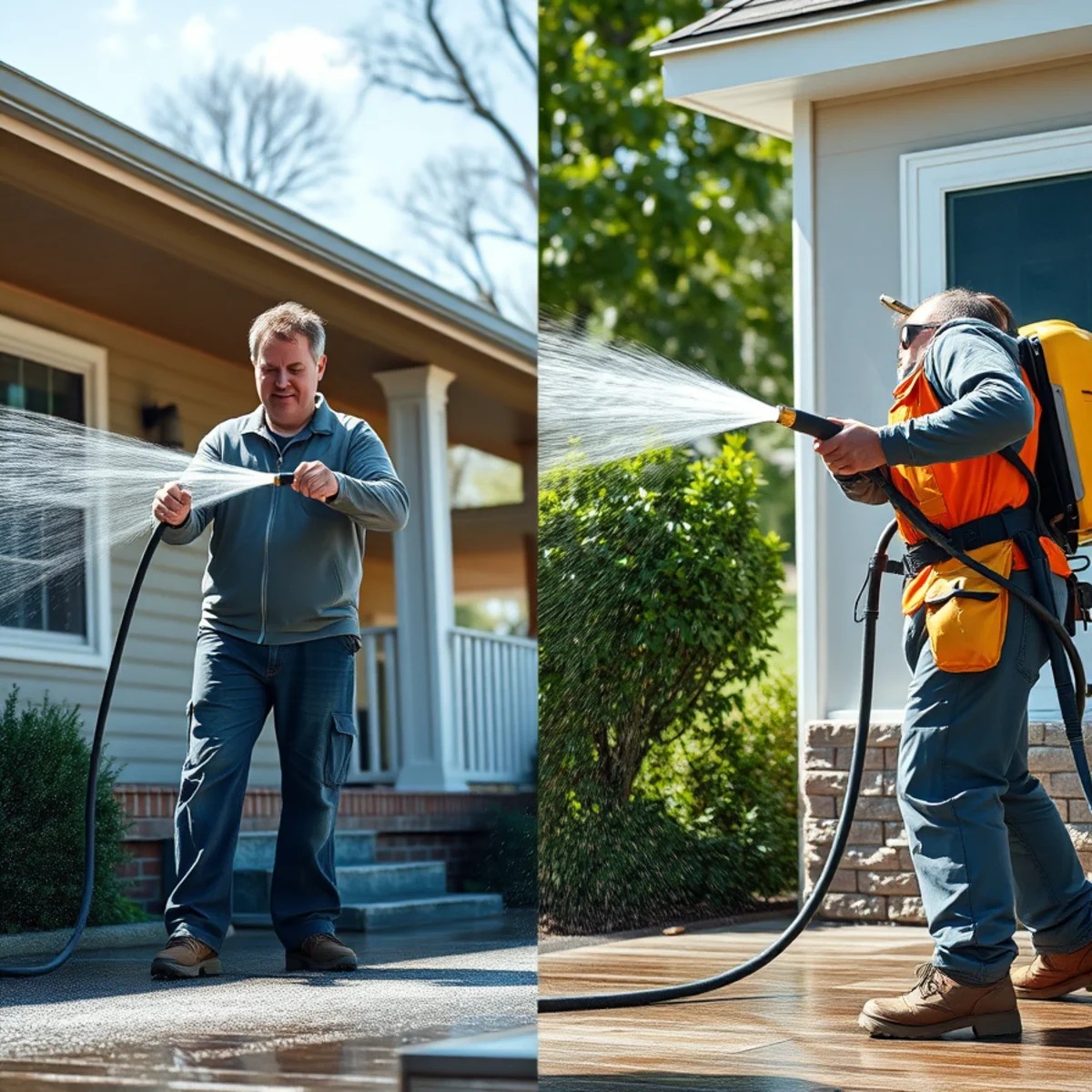
An honest, itemized look at DIY vs professional pressure washing for Massachusetts homes: real costs, safe PSI by surface, hidden risks, and when to hire a pro.
Renting a pressure washer for a weekend feels like the frugal, hands-on choice. But the real question is not "Can I save money?" It is "What does a mistake cost me?" In Massachusetts, where heavy roof algae, freeze-thaw concrete, and older clapboard homes punish wrong moves, the gap between a $50 rental and a $900 siding repair is closer than most homeowners think. This guide gives you the honest, itemized math so you can decide with your eyes open.
The Real Question Behind DIY vs Professional Pressure Washing
Most articles frame this as cheap-versus-expensive. That is the wrong lens. The right question is whether the surface, the height, and the type of grime fall inside what a careful homeowner can handle without damaging the house or getting hurt.
A concrete walkway with light pollen? That is a reasonable Saturday project. A two-story home with black algae streaks (Gloeocapsa magma) creeping across north-facing vinyl siding and an algae-stained roof? That is where good intentions turn into wand marks, water intrusion, and a ladder you should not be on. The decision is really about matching the job to the right tool, the right chemistry, and the right amount of risk you are willing to absorb personally.
Here is the message that should anchor every choice you make: you don't need more pressure; you need the right chemistry. Pressure does not kill algae roots. Biodegradable surfactants do. Once you understand that, half the DIY temptation disappears.
What DIY Pressure Washing Actually Involves (Rent, Buy, or Borrow)
DIY breaks into three paths, and each has a different cost structure.
- Rent. A box store or equipment yard rents a gas pressure washer by the day. You get a machine and usually a basic set of nozzle tips, but no cleaning solution, no soft-wash setup, and no instruction beyond a quick counter walkthrough.
- Buy. A consumer electric washer (roughly 1,300–2,000 PSI) handles light patio and car-wash duty. A gas unit (2,800–3,400 PSI) has the power for concrete but is far easier to damage siding with. You also inherit storage, maintenance, and winterization.
- Borrow. A neighbor's machine saves the rental fee but comes with zero support, unknown wear, and an awkward conversation if it breaks on your watch.
What none of these paths typically include is the thing professionals rely on most: a downstream injector that pulls cleaning solution through the machine at the correct dilution so you can soft wash instead of blast. Without it, a DIYer is stuck doing exactly what they should not do, which is using raw pressure to remove organic stains.
The True Cost of DIY: Rental, Equipment, Chemicals, and Your Time
The sticker price of a rental is the smallest line in the budget. Here is a fuller accounting (treat all dollar figures as general market estimates, not quotes, since rates vary by store and season):
- Rental: roughly $50–$100 per day for a gas unit.
- Cleaning solution / detergent: sodium hypochlorite (bleach solution), a surfactant, and a degreaser can run $30–$70 once you buy the right products.
- Nozzle tips and a surface cleaner attachment: $30–$120 if you do not already own them.
- Fuel or electricity: a few dollars, but real.
- Your time: this is the line most articles skip. A first-timer washing a full house can lose an entire weekend to setup, learning curve, and rework.
- Risk reserve: the invisible cost of redoing the job or repairing a surface you damaged.
Add it up and a "$60" rental routinely becomes a $150–$250 day before you value a single hour of your own labor. The cost per square foot only looks low until something goes wrong.
What Professional Pressure Washing Costs in Massachusetts
Professional pricing depends on square footage, surface type, access, and how much organic growth has taken hold. As general Massachusetts market ranges (again, estimates, not a Wash Bros quote):
- House washing: roughly $250–$600 for a typical single-family home.
- Soft-wash roof cleaning: roughly $400–$700 depending on pitch and staining.
- Driveway or concrete: priced by area and stain severity.
That number is all-in. It includes commercial-grade equipment, the correct cleaning solution matched to your stains, trained technique, the labor, and the liability insurance that protects you. When you ask "is it cheaper to pressure wash yourself or hire someone," the rental almost always wins on paper for one small surface. For a whole house, once you factor in supplies, a lost weekend, and repair risk, the gap narrows fast and often flips.
Side-by-Side Cost Comparison: DIY vs Hiring a Pro
Here is the line-item comparison most competitors never publish:
| Factor | DIY | Professional |
|---|---|---|
| Equipment | $50–$100/day rental | Included |
| Chemicals / surfactant | $30–$70 | Included |
| Nozzles / surface cleaner | $30–$120 | Included |
| Fuel / electricity | A few dollars | Included |
| Your time | A full weekend (no pay) | A few hours, none of it yours |
| Soft-wash capability | Rarely available | Standard |
| Insurance / damage coverage | $0 — you absorb it | Carried by the contractor |
| Repair risk | High on the wrong surface | Low |
| Redo risk | Common with raw pressure | Low |
The honest read: for a small slab of durable concrete, DIY can genuinely cost less. For siding, roofs, and anything organic, the "savings" evaporate the first time you have to redo the work or repair a gouged surface.
Pros and Cons of DIY Pressure Washing
Pros
- Lowest out-of-pocket cost on small jobs.
- Full control of your schedule.
- Satisfying for hands-on homeowners.
- Fine for light, recent dirt on forgiving surfaces.
Cons
- No soft-wash chemistry, so algae regrows quickly.
- Easy to etch concrete, fuzz wood, or crack siding.
- Real injury risk on ladders and roofs.
- All damage and liability lands on you.
- The learning curve eats a weekend.
Pros and Cons of Hiring a Professional
Pros
- Right pressure and right chemistry for each surface.
- Soft washing that kills organisms instead of masking them.
- Trained for height, windows, plants, and electrical fixtures.
- Fully insured, so accidental damage is covered.
- Faster, more even, longer-lasting results.
Cons
- Larger single outlay than a rental.
- You schedule around a crew's availability.
- Quality varies between companies, so vetting matters (more on that below).
PSI, Nozzles, and Why Pressure Settings Matter More Than You Think
PSI (pounds per square inch) measures force; GPM (gallons per minute) measures rinse volume. Both matter, but the nozzle tips and spray angle decide whether you clean a surface or destroy it.
A zero-degree nozzle concentrates all the force into a pinpoint and is essentially a paint-and-wood-stripping tool. A wide fan tip spreads the force and is far safer. The problem is that the same machine, with a different tip held at a different distance, can range from harmless to ruinous. That is why "what PSI should I use to pressure wash my house" has no single answer without naming the surface.
Surface-by-surface safe ranges every homeowner should know:
| Surface | Safe approach | Verdict |
|---|---|---|
| Asphalt shingles | Soft wash under ~100 PSI | Pro only |
| Vinyl siding | 100–500 PSI, wide fan tip | DIY-risky |
| Cedar / softwood | Under ~200 PSI | Pro preferred |
| Historic brick / mortar | Under ~400 PSI | Pro only |
| Stucco / EIFS | Under ~150 PSI | Pro only |
| Composite deck | 500–1,000 PSI | DIY-careful |
| Metal roof | 500–800 PSI | Pro preferred |
| Concrete driveway | 2,000–3,000 PSI | DIY-OK |
Notice the pattern: the surfaces people most want to clean (siding and roofs) sit at the low, unforgiving end, while the rented gas machine is built for the high end. That mismatch is where DIY damage happens.
Pressure Washing vs Soft Washing: A Distinction DIYers Often Miss
Power washing and pressure washing rely on force, sometimes with hot water for grease. Soft washing flips the formula: low pressure paired with biodegradable surfactants and a controlled sodium hypochlorite solution that actually kills the algae, mold, mildew, lichen, and moss at the root.
This is the single biggest gap between amateur and professional results. A rented machine and a generic nozzle blast the green off the surface, but the spores stay behind, so the stains return within months. A proper soft washing setup uses a downstream injector to apply the right chemistry at the right dilution, so the growth dies and stays gone far longer. Most DIY renters simply do not have that capability, which is why "why do professionals use soft washing instead of pressure washing" comes up so often. The answer: because pressure does not kill what is staining your house. Chemistry does. For a deeper comparison, see our guide on pressure washing vs soft washing.
The Hidden Risks of DIY: Siding Damage, Water Intrusion, and Injury
The same force that strips dirt strips paint, gouges wood, and drives water where it does not belong. The damage often does not show up until later.
- Siding damage. Too much pressure on vinyl cracks panels and forces oxidation chalk into uneven patches. On wood siding it raises the grain and leaves a permanent fuzzed texture.
- Water intrusion. Spraying upward or at a steep angle pushes water behind siding and into wall cavities, where it feeds hidden mold and, over time, wood rot. You cannot see it happening, which is what makes it dangerous.
- Injury. A high-pressure stream can cut skin and cause serious infection. Kickback on a ladder is how falls happen.
Can you damage your house by pressure washing it yourself? Absolutely, and the most expensive damage is the kind you do not notice for months.
Common DIY Pressure Washing Mistakes That Lead to Costly Repairs
- Too much pressure on the wrong surface. Vinyl, cedar, stucco, and aging mortar all fail under a tip held too close.
- Spraying upward under siding. This is the water-intrusion mistake. Always work top-down at a downward angle.
- Etching concrete and wood. A narrow nozzle leaves streaks and wand marks that do not buff out.
- Skipping the chemistry. Blasting algae removes the stain, not the organism, so it returns fast.
- Ignoring oxidation on vinyl. Scrubbing chalky siding with pressure creates blotchy, uneven results that need a proper cleaning solution to fix.
- No landscaping pre-soak or runoff awareness. Concentrated solution kills plants and, on a well, contaminates groundwater if you are not managing runoff.
Safety First: Ladders, Roofs, and the Reality of Pressure-Washer Injuries
Pressure washers send thousands of people to the emergency room every year in the United States, according to consumer-safety reporting (cited here as a widely reported figure, not a precise current count). Lacerations, eye injuries, and falls top the list. The wand recoils. Wet surfaces are slick. A ladder plus a kickback-prone wand plus a roofline is a combination that puts homeowners in the hospital.
Is pressure washing a roof safe to do yourself? Honestly, no. Roof work combines height, slick algae, fragile shingles, and the granule loss that comes from too much force. This is the clearest "hire it out" category there is. The crews who do it daily use roped-off low-pressure systems and follow Roof Cleaning Institute of America (RCIA) style safety practices for exactly this reason.
Surfaces You Should Never DIY (Roofs, Stucco, Older Siding, Painted Wood)
Some materials are simply unforgiving, and Massachusetts has a lot of them.
- Asphalt shingle roofs. High pressure strips the protective granules and voids warranty considerations. Shingle granule loss shortens roof life dramatically. Roof cleaning is soft-wash-only territory.
- Stucco and EIFS. Under ~150 PSI or you crack and pit the surface.
- Older clapboard and painted wood. New England's historic colonials and Victorians have aged paint and soft wood that high pressure destroys. These need low pressure and the right detergent.
- Historic brick and lime mortar. Under ~400 PSI; older mortar washes right out under a power washer.
When you are not certain a surface can take the pressure, that uncertainty is the answer. Slow down or call a pro.
When DIY Pressure Washing Makes Sense (Small, Low-Risk Jobs)
DIY is a perfectly reasonable choice when the stakes are low:
- A concrete walkway, patio slab, or section of driveway with light dirt.
- A composite deck that needs a gentle refresh (500–1,000 PSI).
- Cobwebs, pollen, and a season of dust on a ground-level, durable surface.
- You can keep both feet on the ground, with no ladders and no roof.
- A less-than-perfect result is acceptable to you.
Is renting a pressure washer worth it? For exactly these jobs, yes. The machine matches the task and the downside is small.
When You Should Hire a Professional
Call a pro when any of these are true:
- The job involves your roof, a second story, or any ladder work.
- You see black streaks, green algae, or mold that keeps coming back (a chemistry problem, not a pressure problem).
- The surface is vinyl siding, painted wood, stucco, or older brick.
- You want an even, thorough, long-lasting result the first time.
- You simply do not have the time, the soft-wash equipment, or the appetite for the risk.
Should you buy, rent, or hire? Buy if you have ongoing small-surface needs. Rent for a one-off durable-concrete job. Hire for siding, roofs, height, or anything organic.
Why Insurance, Licensing, and Liability Matter in Massachusetts
This is where the financial argument gets concrete. When you do the work yourself, every risk lands on you. Crack a window, gouge the siding, or push water into a wall cavity, and the repair comes straight out of your pocket. There is no one to make it right.
Do pressure washing companies carry insurance? Reputable ones do. A fully insured contractor carries that liability instead of you. If a crew accidentally damages something, their insurance covers it. Wash Bros is fully insured and provides a certificate of insurance on request, so an accidental-damage mishap is the company's responsibility to fix, not yours. When you are vetting any contractor, ask whether they carry liability insurance and whether they hold an HIC registration in Massachusetts. That registration is reader advice for your own protection when comparing companies.
How Massachusetts Weather and Algae Make This Decision Different
Our climate makes this harder than it is in drier regions. The why-it-matters angle here is genuinely local.
- Inland humidity and tree cover. Heavy black algae and moss thrive on north-facing roofs and siding across central Massachusetts. These require soft washing and chemistry a DIY renter cannot replicate. Towns like Worcester see this constantly.
- Coastal salt-air corrosion. Near the shore, salt accelerates grime and corrosion, and the cleaning approach has to account for it.
- Freeze-thaw cycles. If you etch your concrete with a DIY mistake in summer, winter's freeze-thaw cycle works into those micro-channels and spalls the surface far worse by spring.
- Road salt and snow residue. Driveways, walkways, and foundations carry salt and sand by spring that benefit from proper technique and sometimes hot water.
- Pollen season. A thick yellow coat each spring prompts DIY attempts; the best window for house washing is late May through June, once pollen drops.
A crew that works across the region every week knows how to clean a 1920s home in Salem differently from new construction in Newton. That local read on siding types, roof pitch, and seasonal timing is hard to get from a rental-counter walkthrough.
The Damage-Cost Math: A $300 Wash vs a $900+ Siding Repair
Run the worst case. A professional house wash might cost a few hundred dollars. A single cracked or gouged vinyl siding section, matched and replaced by a contractor, can run $900 or more once labor and color-matching are factored in. Force water behind that siding and feed hidden mold, and you are looking at remediation that dwarfs any rental savings.
The roof version is even starker. Many insurers in the region now flag algae-stained or visibly dirty roofs and can decline or drop coverage. A professional soft wash can add 10–20 years of roof life and helps you avoid a $15,000–$30,000 replacement. Weighed against that, the DIY savings on a rental are a rounding error.
Time Investment: A Weekend DIY vs a Few Pro Hours
A first-time DIYer washing a full house budgets a weekend and often spends more: hauling the machine, learning the nozzles, mixing solution, doing the work, and frequently redoing patches. A trained two-person crew does the same house in a few hours, none of which is your time. How long does it take to pressure wash a house yourself? Plan on a full day minimum for a small home, and a weekend for anything two-story. If your time has any value to you, that line item alone changes the math.
How to Choose a Reputable Pressure Washing Company
Not all crews are equal. Look for:
- Proof of liability insurance, with a certificate available on request.
- Surface-appropriate technique, including real soft-wash capability.
- Biodegradable, eco-conscious cleaning solutions and runoff awareness.
- Clear communication about which method suits your surfaces.
- Genuine local reviews and a track record in your area.
A company that can explain why it soft washes your roof instead of blasting it is showing you the expertise that protects your property.
Questions to Ask Before Hiring a Pressure Washing Contractor
- Are you fully insured, and can I see a certificate of insurance?
- Will you soft wash my roof and siding, or pressure wash them?
- What PSI and chemistry will you use on my specific surfaces?
- How do you protect landscaping and manage runoff, especially on well water?
- Do you hold an HIC registration in Massachusetts?
- Can you share recent local reviews or references?
The right answers reveal a contractor who treats your home the way you would. For more, see our guide on questions to ask before hiring a pressure washing contractor.
Final Verdict: Which Option Is Right for Your Home?
DIY wins for small, durable, ground-level surfaces with light dirt and a forgiving margin for error. A careful homeowner with a rented machine can handle a concrete walkway just fine.
Everything else, the roof, the siding, the second story, and any stubborn organic growth, favors a professional. Not because you are incapable, but because the right outcome depends on soft-wash chemistry, surface-correct pressure, height safety, and insurance that you cannot easily replicate for one weekend. The decision is not about pride. It is about matching the job to the right tool and absorbing the right amount of risk.
If you want the job done safely and right the first time, Wash Bros is a local, family-run company founded in 2023 by brothers Louis and Dominic, fully insured, with a 5.0 average across 130 reviews. We will look at your surfaces, recommend the honest right approach, and never push pressure where chemistry is what you actually need. Reach out for a free, no-pressure estimate through our contact page or call us at +1 (351) 242-0666.
Frequently Asked Questions
Need Professional Exterior Cleaning?
Wash Bros provides affordable, dependable pressure washing across Massachusetts. Get your free estimate today.
Get a Free Estimate